




The College of Arts & Human Sciences is dedicated to supporting UW-Stout’s polytechnic mission through applied learning. Our programs are diverse, but we are united in our dedication to making the world a better place.
The projects and events on this page will give you an idea of the work our students and instructors are doing to create a better world. We invite you to explore the work we’re doing, join us for an event, and reach out to learn more about the ways we are Helping Humanity Flourish.
Starting Strong: Fall 2026 Update
Over the summer, the College of Arts and Human Sciences received three major grants to advance research and expand our programs. This funding will support expanded access to training for social workers, increased access to substance abuse treatment in rural communities, and research into eco friendly beef packaging.
Two of the three awards focus on expanding mental health to rural communities in Wisconsin. Rural communities face mental health challenges at rates comparable to urban areas, yet access to care remains critically limited in comparison. According to the Rural Health Information Hub, only about 20% of mental health and human services professionals offer services in rural communities, and 31 of Wisconsin’s 72 counties are designated as Mental Health Professional Shortage Areas (MHPSA). The National Alliance on Mental Illness estimates that more than 1.5 million Wisconsin residents live in communities without adequate supply of mental health providers.
Through two new Rural Health Initiative grants totaling over $4.7 million, UW-Stout is working to change that. We will be expanding our Master’s in Clinical Mental Health Counseling program and introducing a Masters of Social Work program, both designed to serve adult learners in rural areas through a part time hybrid modality. This design will allow students to earn their degree without leaving the communities where they already live and work, helping to increase retention in rural mental health positions by investing in the people who know and understand the unique challenges of rural life. The Masters of Social Work program is also designed to have multiple start dates throughout the year, so students will be able to begin classes when it best works for them rather than waiting until September.
The second grant will support the development of a Rural Clinical Training Hub to provide increased resources to substance abuse counselors across the state. This Hub will be equipped with modern technology designed to support comprehensive remote oversight and training for students regardless of their proximity to campus. The ability to receive remote supervision will remove barriers such as commuting expenses that often dissuade students from seeking rural placements for their clinical supervision. This project also includes updates to UW-Stout’s B.S. in Rehabilitation Services program which will integrate substance use counseling into the program more directly, ensuring that every student is equipped with the training they need for substance abuse counselor licensure upon their graduation.
Finally, researchers in our food science program are exploring ways to use a byproducts of kombucha and cranberry production to extend the shelf life of beef. This project aims to develop a nanocellulose film out of kombucha SCOBY and cranberry pomace that is anticipated to extend the shelf life of beef by at least one day. This project will create new income streams for Wisconsin’s cranberry and kombucha producers, and it will help reduce waste for the state’s beef producers and grocers.
As we look forward to the 2026-27 school year, the UW-Stout Polytechnic College of Arts and Human Sciences is proud of the ways faculty and staff across our eight departments and forty four programs are helping humanity flourish.
ART 101 and the Practice of Noticing Details
Rachel Bruya, Associate Professor
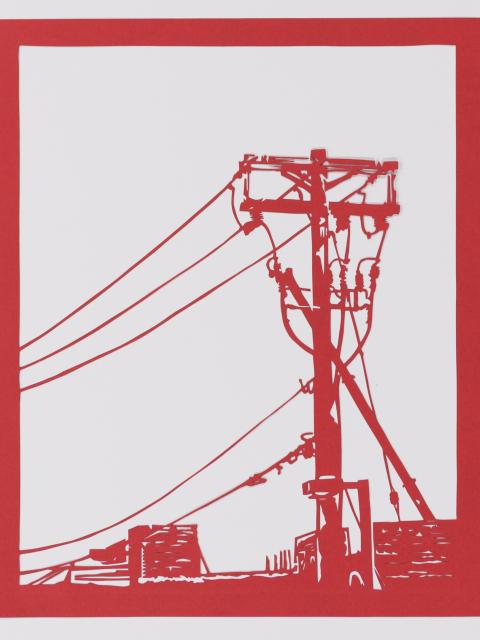
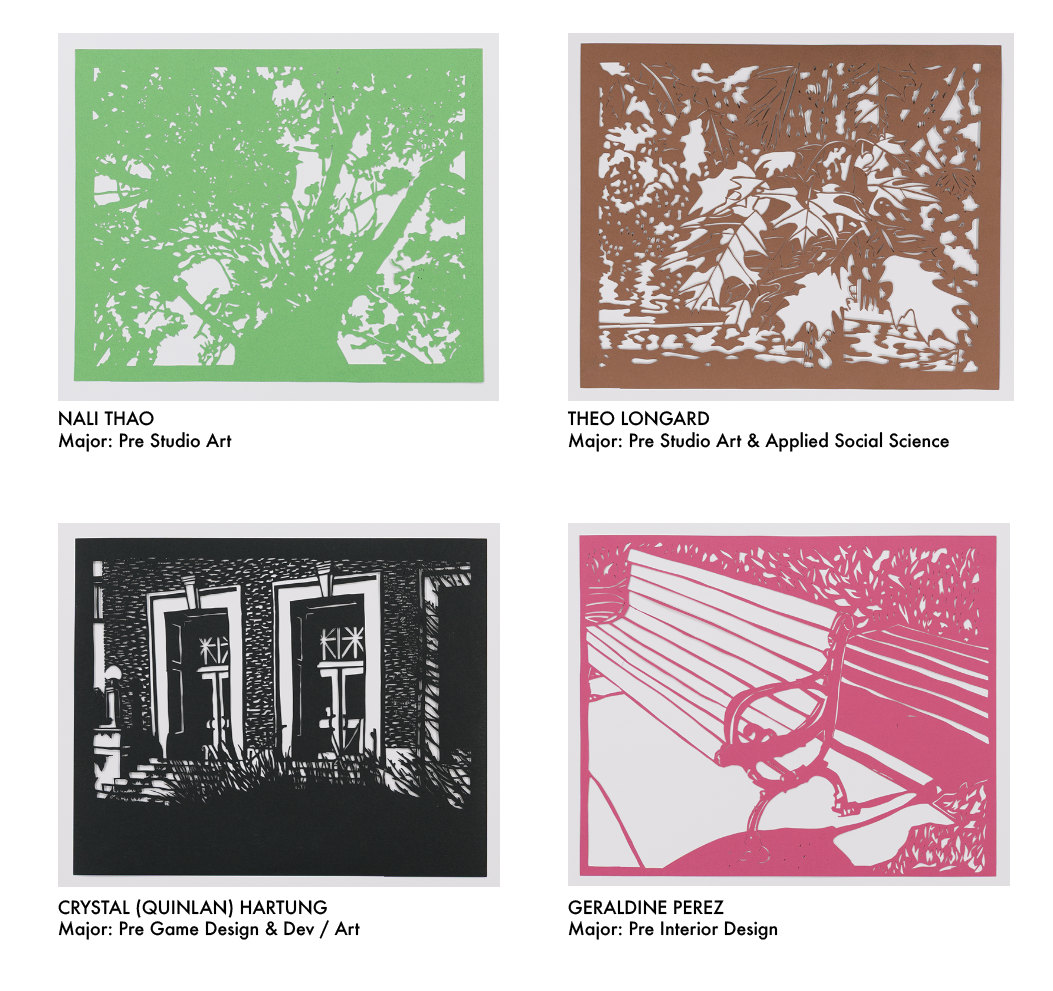
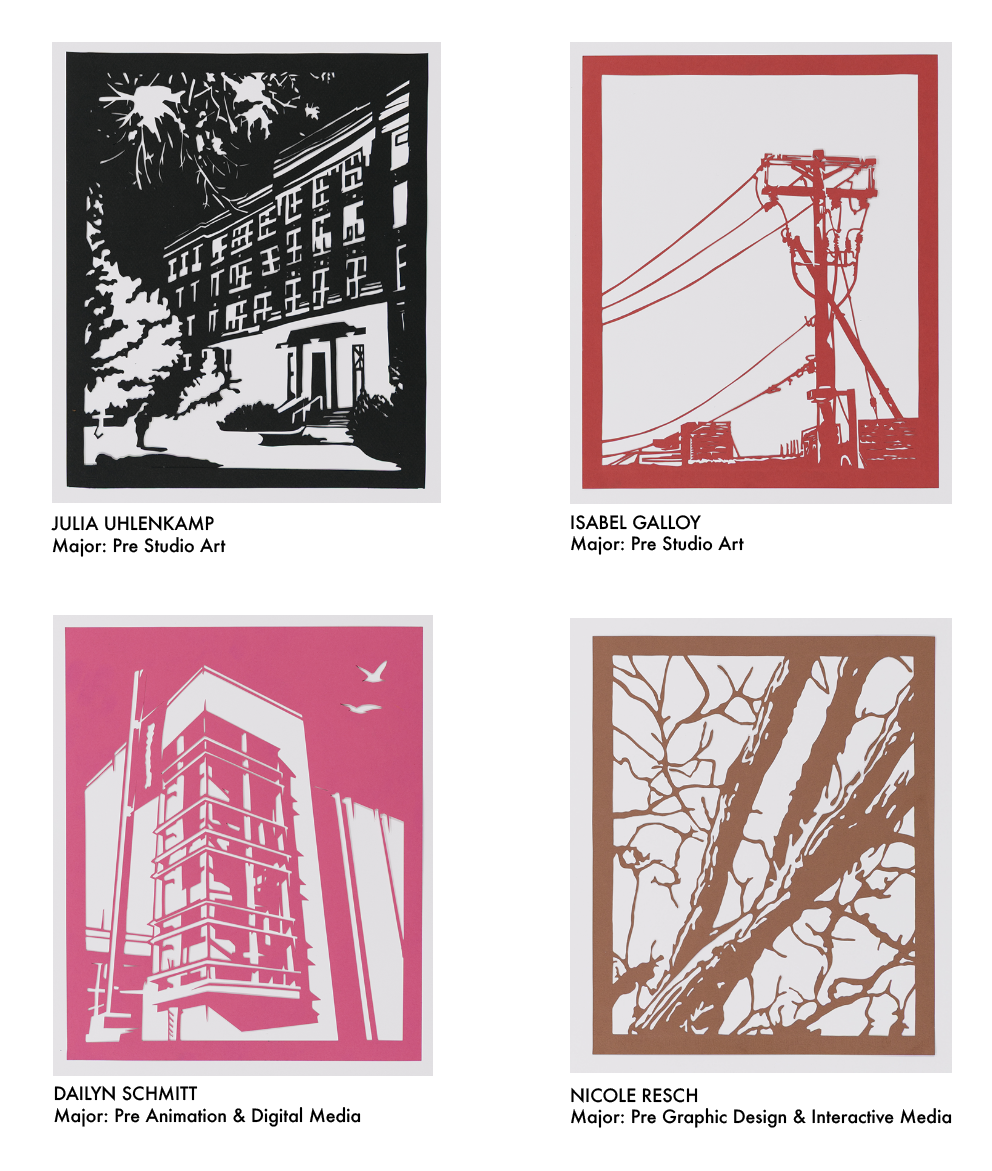
At its core, art and artmaking helps humanity flourish. It strengthens mental and emotional health by lowering cortisol and helping regulate mood. It offers a way to express joy, conflict, and complexity when words fail. Artmaking builds resilience to help build coping skills and fosters a sense of meaning, purpose, and hope. Associate Professor Rachel Bruya had all these benefits and more in mind when designing a papercut project for her 2-D design class in the fall semester of 2025.
Bruya explains that the class began the project by going on a campus walk together and gathering photographs, which would be the basis for the “view”. Their walk started in the open space area just in front of the Applied Arts building, and they had the amazing experience of witnessing a bald eagle soaring above them. Students saw inspiration in their surroundings, and it gave them time and space to notice details. One of the goals for the project was to give students the opportunity to translate the banal to something that gives more meaning to their day-to-day life as a student.
The class continued their walk across campus looking at both human made and natural environments and appreciating the world around them. The campus walk was a source of inspiration and camaraderie building amongst the class. It was inspiring to Bruya as their instructor that they could find connection with classmates through the campus walk, and it was uplifting seeing groups of students wandering off to “find” their views together.
The class then returned to the lab and began the process of translating the photographs to pure black and white designs, which were then transferred to color paper, and cut. The final paper cuts are presented laid on to a white paper backing.
The project trains the students to “see” both an overall balanced composition and the details they will need to capture for their final pieces. It helps them apply their knowledge of composition and explore positive and negative space, and it allows them to utilize their cutting skills in the process of translating an image to a single cut piece of paper.
We invite you to notice the details in the pieces below, keeping in mind that shadows and blurring sometimes occurs due to how the colored paper lays on to the white paper. We also invite you to consider the details in your own day-to-day experiences and to consider taking your own artmaking walk—or incorporating the act of noticing details into your own daily life.
Transforming Rural Healthcare
Nels Paulson and Jeffrey Sweat, Professors
Recovering from infection, managing chronic conditions, and healing from surgery may be more comfortable in the future. Hospital at Home programs like the ones UW-Stout professors Nels Paulson and Jeffrey Sweat study allow patients to receive medical care outside of a traditional hospital environment. Patients in these programs often recover more quickly, and providers get an invaluable look into the ways that a patient’s living situation may impact their health. Hospital at Home programs can also alleviate strain on hospitals, increase patient compliance with medications, and reduce the risk of exposure to infection.
Paulson and Sweat’s research explores barriers that patients and providers face in adopting health at home models.
Paulson and Sweat’s most recent research used zip code data to estimate potential Hospital at Home patients’ socioeconomic status and their ability to access the internet. Data about the ways those factors impacted health outcomes can help hospitals better understand which patients could benefit the most from Hospital at Home programs. Their research also revealed potential gaps in care, and hospitals can use it to make sure Hospital at Home programs are implemented intentionally and do not end up continuing or worsening existing inequalities.
In another study, Sweat and Paulson spent time researching Hospital at Home programs in urban, suburban, and rural communities. With increased closure of rural hospitals, Hospital at Home has the opportunity to transform care for the one in five Americans in rural areas. Their research noted the unique challenges that patients and providers faced in rural communities, where resources such as health care providers, rideshares and mobile medical units are less common. Researchers worked to provide guidance for healthcare systems offering Hospital at Home models to help ensure that the programs they build will be robust enough to overcome those challenges.
Additional research on reasons that patients decline Hospital at Home programs exposed the importance of increased clarity around program offerings and insurance policies related to home care. This research also exposed patient concerns about the ways that Hospital at Home would impact both their daily lives and their recovery, with women especially noting concerns about their ability to perform domestic tasks while recovering. Other patients expressed concerns about factors such as pets, the cleanliness of their home environments, and the disruption that visits from healthcare providers could cause for themselves and the others in their homes. The study encouraged additional research to expose other barriers to Hospital at Home adoption, but it provides a valuable insight to help hospitals better understand and mitigate patient concerns.
This research provides valuable insight into the ways Hospital at Home impacts providers and patients, and it helps reveal those outside of the program who could benefit from it.
Read Paulson and Sweat's published articles:
- Why U.S. Patients Declined Hospital-at-Home during the COVID-19 Public Health Emergency: An Exploratory Mixed Methods Study
- Staff Successes and Challenges with Telecommunications-Facilitated Patient Care in Hybrid Hospital-at-Home during the COVID-19 Pandemic
- A Pathway for High-Value Home Hospital Care in the United States: Statutory, Reimbursement, and Cybersecurity Strategies in the Age of Hybrid Care
- “Individual- and Community-Level Predictors of Hospital-at-Home Outcomes”, published in Population Health Management
Solving Problems to Help Humanity Flourish
Kristyn Blessing, Lecturer
Starting college isn’t easy. As students start a new phase in a new place, it’s common to feel lost or alone. An assignment in Lecturer Kristyn Blessing’s Composition class helped to mitigate those fears. The assignment allowed Blessing to learn about challenges students face while helping those students discover resources that are available to help them navigate this new chapter of their lives. Beyond that, the work they did for the class encouraged them to explore their own abilities to make positive change.
The project centered around a simple question: What problems do students like them face? And how can we, as part of the College of Arts & Human Sciences, mitigate those problems to help humanity flourish?
As part of this project, students were asked to identify communities they belong to. Many identified with their chosen fields of study or as student athletes, non-traditional students, or neurodiverse students. They were then asked to research issues that impact their communities, explore what solutions exist, and propose additional solutions to help combat the concerns they found. The project helped students learn to communicate concerns productively, find existing resources, and create solutions that would be effective without duplicating work.
One student focused their project on general education courses with the initial belief that these courses were not useful for their future. Their research led them to current legislation changes in Wisconsin related to general education courses, allowing them to explore current events that directly impacted their education. The student learned the value of these courses in creating well-rounded individuals, and their final project explored ways that UW-Stout can teach students to value these courses without overwhelming them.
Another student’s project focused on challenges unique to non-traditional students, who typically come to college with more experience than a student coming directly from high school. This student discovered the credit for prior learning options available at Stout, but she pointed out that the process is difficult to navigate and is not well advertised. She recommended the university do more to highlight opportunities to earn credit for prior learning and recommended additional programs such as partnerships with local employers to help empower adult learners.
Across projects, students stressed the importance of resources targeted to their communities. They noted that while there are resources on campus for many of their concerns, a lack of community focus led to students finding less value in them. Some also noted that vague or broadly-focused activities can feel like simply another thing to do rather than something that will be valuable to them. A common alternative was to propose activities with a smaller target audience that would bring likeminded students together to help them find community and address their common concerns.
At the end of the project, leadership from the College of Arts and Human Sciences visited the class for presentations. They heard student concerns and helped answer questions. The instructor noted that this audience helped students feel like they had a voice, and knowing that they would be sharing their concerns with people who had agency helped students find concrete value in the project.
Through this project, students learned to identify concerns in their communities, and they got the chance to explore the nuances of those issues. They also learned how to find and ask for help, and they got to explore ways that they could make an impact in the lives of those around them.