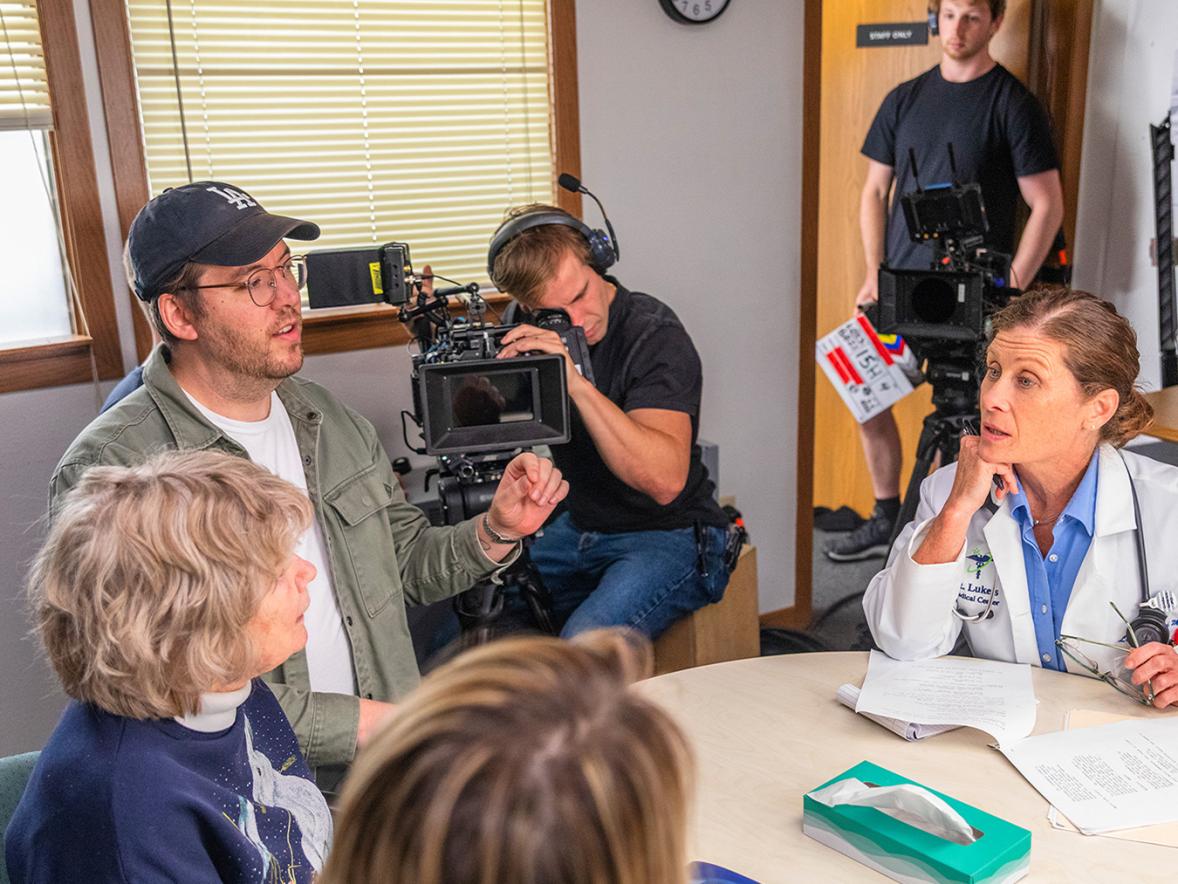




A new Artificial Intelligence (AI) Assisted Film and Video Production course will launch at UW-Stout in summer 2026. The course, possibly a first-of-its-kind in the Universities of Wisconsin, was developed by a video production faculty trio – Keif Oss, Jonny Wheeler and Co O’Neill. Students in the course will produce a short narrative film, using AI tools from pre-production concepts to completion.
“It is certainly on the vanguard. We are moving beyond ‘allowing’ the use of AI in filmmaking to establish it as a baseline competency. Students will use AI tools to generate scripts, storyboards, shot lists, visual effects, video, music, voice-overs and sound effects,” said Wheeler, who will teach the course.
The course will also include films and shorts as examples, including AI-generated images and shots used in a short by Wheeler that is loosely based on the Old English epic poem “Beowulf,” but which takes place on a post-human Earth with an ape as the hero.

The idea for the course germinated in spring 2025, when Oss applied for professional development funding to attend the National Association of Broadcasters conference in Las Vegas, specifically to study emerging uses of AI in video production, filmmaking and entertainment.
“At that time, most industry applications centered on productivity rather than replacing human image creation, though AI-generated imagery was clearly already a part of many preproduction and visualization pipelines,” Oss said.
While there, Oss connected with Curious Refuge, a leading AI production training company, and FBRC.ai (Fabric), which consults on AI workflows for feature films and other high production value projects.

Following NAB, Oss, Wheeler and O’Neill leveraged their combined experiences to apply for a Chancellor’s Professional Development Fund grant supporting teaching excellence. With additional departmental support, they secured resources to purchase training with Curious Refuge and complete specialized online courses in AI filmmaking.
“We intentionally divided focus areas: Jonny concentrated on AI-driven narrative filmmaking, virtual production and speculative fiction; Co on advanced narrative workflows; and me on documentary production using AI-assisted methods,” Oss said. “This distributed learning diversely informed the development of our new course. Micheal Heagle, animation, had also been studying this extensively and provided valuable contributions to the course’s design.”
Which tools do they use? Although new AI tools pop up daily, they recommend:
Artist.io for voice over, ElevenLabs for sound effects, Gemini for scripts, Kling and Midjourney for images, Sora to generate videos from images, Suno for music and VEO (Flow) for video.
However, everything is changing so fast, O’Neill said. “The best tool for something today might be a different tool next week, and new platforms – or new names for old platforms – are popping up monthly. Nano Banana, for example, is Google’s image generator under a new name that they announced in November,” he said.
O’Neill, who used to work in visual effects, noted that many students are already using AI to brainstorm script ideas and camera shots, to experiment with visual effects, to generate mood boards or to adapt hand-drawn storyboards into pitch-ready deck elements.

“AI’s potential in making amazing-looking visual effects without the time, expense and danger of a full production is undeniable. The speed at which a creator can iterate! AI is an amazing pre-production tool because you can try out thousands upon thousands of shots and shot combinations before getting the whole crew together,” said O’Neill, a fan of the democratization of the filmmaking process.
“I feel that AI tools are equivalent to inexpensive, high-quality cameras, editing software, lighting and other equipment. Any tool that helps someone visualize a story is a good thing,” he said.
With a focus on narrative cinema, Wheeler also sees generative artificial intelligence (GenAI) as most useful in the pre-production and ideation phases. “It is an incredible tool for ‘world-building,’ helping us visualize the iconography for a new landscape before we ever pick up a camera. It allows us to iterate rapidly on set designs, color palettes and lighting schemes,” he said.

Oss’s interests lie in how AI can accelerate informed decision-making and strengthen the overall filmmaking workflow. In his documentary courses, students use Elicit and Perplexity as elevated forms of research support. Elicit helps to cross-reference peer-reviewed journals and legitimate studies, while Perplexity enables them to investigate topics, identify resources and locate subject-matter experts. ChatGPT can help them confidently draft emails and clarify their goals when contacting potential interview subjects or organizations.
“I frame AI as a starting point, not a replacement for authentic communication, but for students who are apprehensive or inexperienced, it lowers the barrier to initiating human contact. In this way, AI becomes a scaffold that supports and strengthens their communication skills,” Oss said.
A means to enhance, not replace human creativity
While the video production faculty sees AI as a means to enhance the traditional creative pipeline, it cannot replace it, as all forms of AI filmmaking need human input. O’Neill and Wheeler do not recommend using AI to replace the human element of performance. “Gen AI should augment the diegesis, not entirely replace the elements that give a story its soul,” Wheeler said.

O’Neill added, “Acting will never be good with AI because so much of performance is nuanced. AI could help with replacing wardrobe, de-aging or stuff like that. But there will never be enough data centers in the world that can replicate the delicate pauses and intonation of a performance like George Clooney in ‘Michael Clayton’ or Zoe Saldaña in ‘Star Trek.’”
Oss also noted that “AI isn’t always necessarily faster. It doesn't immediately get anything right. Almost every artifact you generate takes a further human curation and expansion,” he said, adding, “If your approach is to feed a prompt, copy it, then paste that as your work, 1) It’s not your work, and 2) It’s probably not good work. It only gets you to a point where you can leap from the idea lead and take the next steps.”
As UW-Stout continues to strengthen its 360-degree approach to artificial intelligence, embedding skills across all programs, faculty experts across degree fields build on their growing knowledge with research spanning GenAI, machine learning, AI deep research methods and more.
The university’s AI Fellows and AI Innovation Committee, led by faculty and staff, ensures AI is embedded into learning, operations and innovation, while directing AI integration, governance, ethics and literacy. The interdisciplinary AI Fellows are supported by 2023-25 Workforce Development funding.
UW-Stout’s School of Art & Design is one of the largest public art schools in the Midwest. It offers bachelor’s degrees in animation and digital media; game design and development-art; graphic design and interactive media; illustration; industrial and product design; interior design; studio art; arts administration and entrepreneurship; fashion design and development; and video production, and an M.F.A. in design. UW-Stout also has a new program in game and media studies.