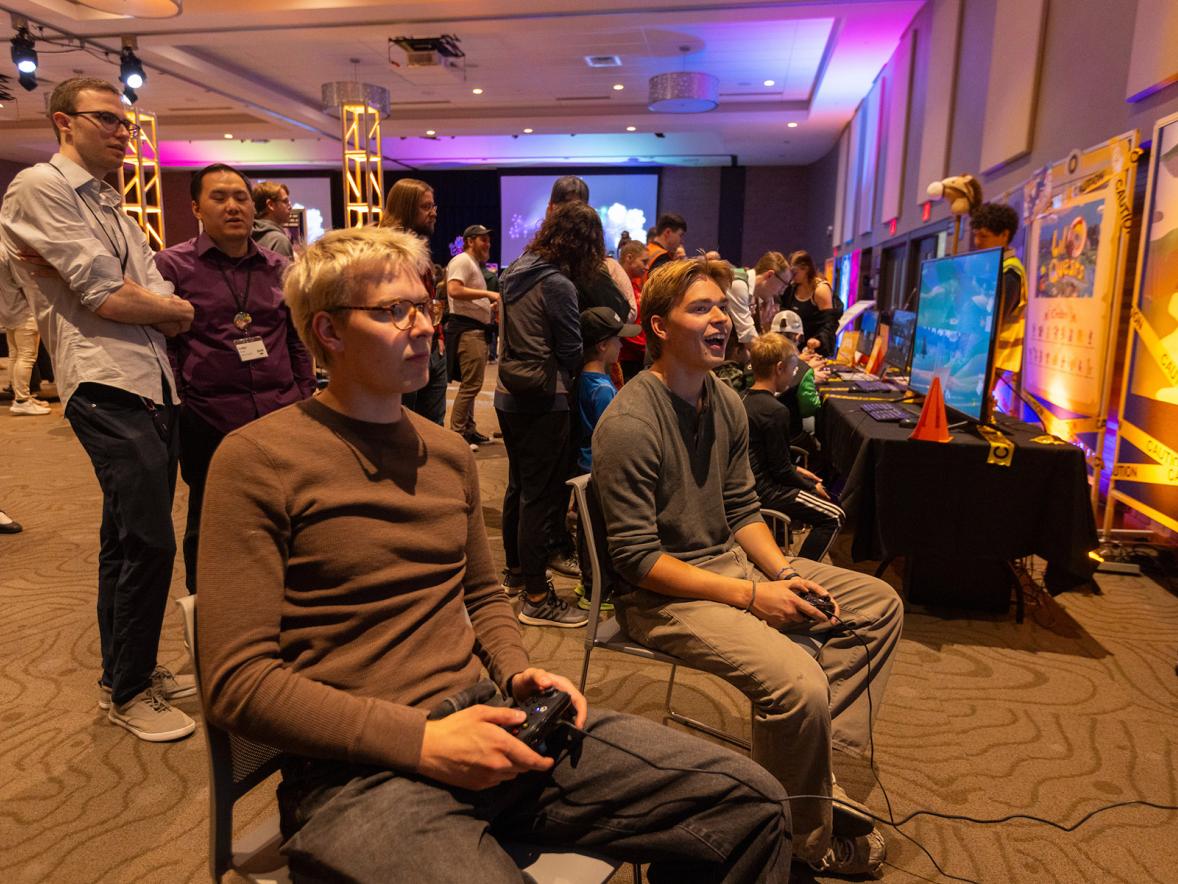






An Aesop’s fables-inspired racing game, a haunted hotel and a futuristic repair shop are all on the menu for players at the Stout Game Expo, western Wisconsin’s largest game developers’ event, featuring the creative works of about 250 University of Wisconsin-Stout students. SGX is from 6 to 9 p.m. on Wednesday, Dec. 10, in the Memorial Student Center Great Hall.
Come play games — from cozy tabletop experiences to intense 3D races and multiplayer competitions — all created by first-year to senior students in game design and development-art and the game design concentration in computer science, as well as M.F.A. in design students. All digital games will be available to play online after Dec. 10.
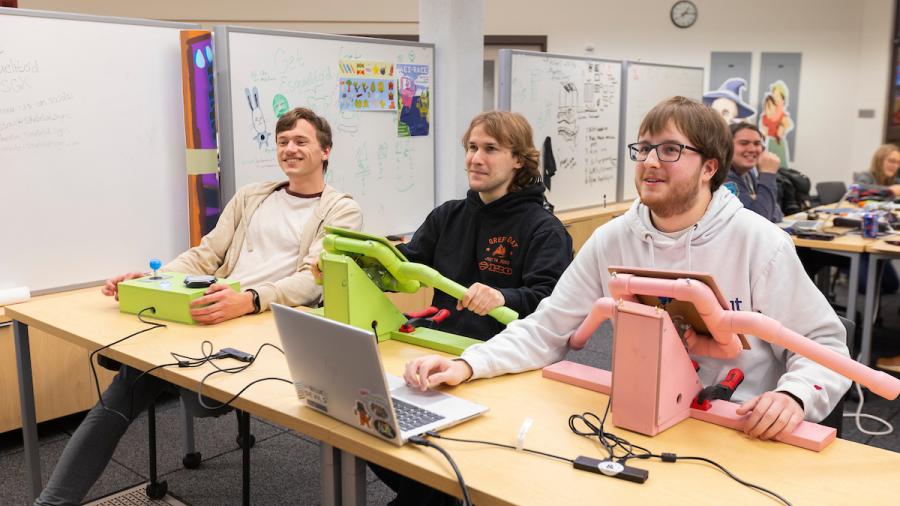
Students in the Exploratory Game Design courses, taught by Karl Koehle and Michael Tetzlaff, are exploring unique gaming experiences, including alternate controllers for their games:
- AES-RACE: A cooperative four-player racing game based loosely on Aesop’s fable “The Tortoise and the Hare.”
- Hazard Hotel: A single-player puzzle game, in which a character is directed through an old, haunted hotel with the goal of repairing it.
- Retro Repair: An augmented reality (AR) experience, where players repair gaming consoles in a futuristic, cutting-edge, zero-gravity workshop.
- Clean Break: A comical two-player game, where one is a dinner plate trying to roll to the dishwasher, and the other, Mr. Ferguson, a crazy old man with a broom, tries to smash it.
- Stars & Spurs: A playful shape-drawing adventure, where players control characters in a child-like imaginary play scene by drawing shapes and gestures into a Wacom digital drawing tablet.
Koehle teaches game design-art in the School of Art & Design, and Tetzlaff teaches game design-computer science in the College of Science, Technology, Engineering, Mathematics & Management. Students work in teams, collaborating across degrees to develop their games.
“Michael and I had a collaborative teaching effort,” Koehle said. “Our classes were scheduled to meet during the same time, allowing us to provide critique and insights to each other’s teams and assist students based on our own disciplines throughout the semester.”
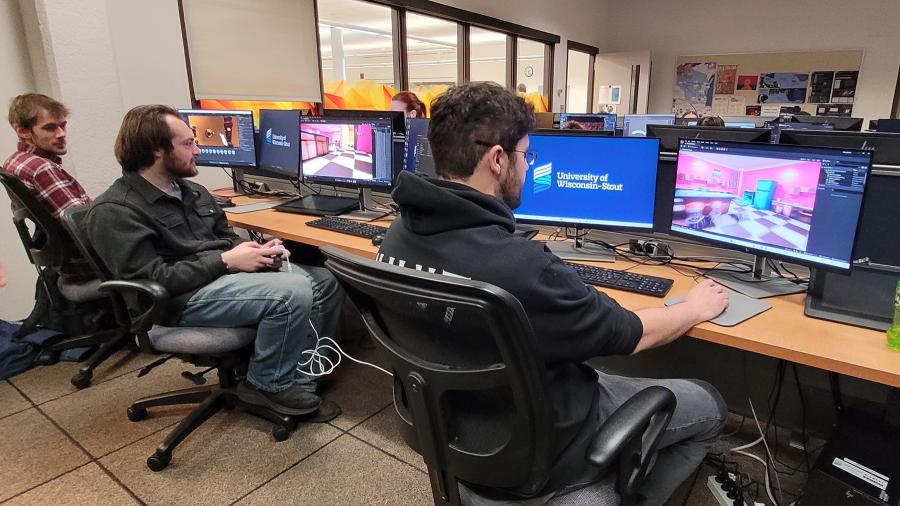
The instructors selected the challenging design constraint to create unique gaming experiences, inspired by the novel interfaces and games on display at the “Alt+Control GDC” exhibit at the international Game Developers Conference.
Also running this week are the STEMM Student Expo from 1 to 3 p.m. on Thursday, Dec. 11, in the Memorial Student Center Great Hall and ballrooms. Explore 300-plus STEMM students’ research in more than 100 projects across a dozen fields of study. The event is coordinated by the Hospitality Convention/Meeting Planning class.
The School of Art & Design Senior Show will feature capstone projects by more than 100 seniors from 6 to 9 p.m. on Friday, Dec. 12. SOAD students will display their creative works in exhibits throughout Applied Arts and Micheels Hall.
AES-RACE
In Aes-Race, players race against each other as turtles and rabbits in three-wheel rickshaw tuk-tuk vehicles. Aiden Rogowski and Aidan Musil developed the physical steering controllers out of wood, PVC, microcontrollers and sensors. Caleb Budde led the racetrack development by programming tools to quickly revise the course design.
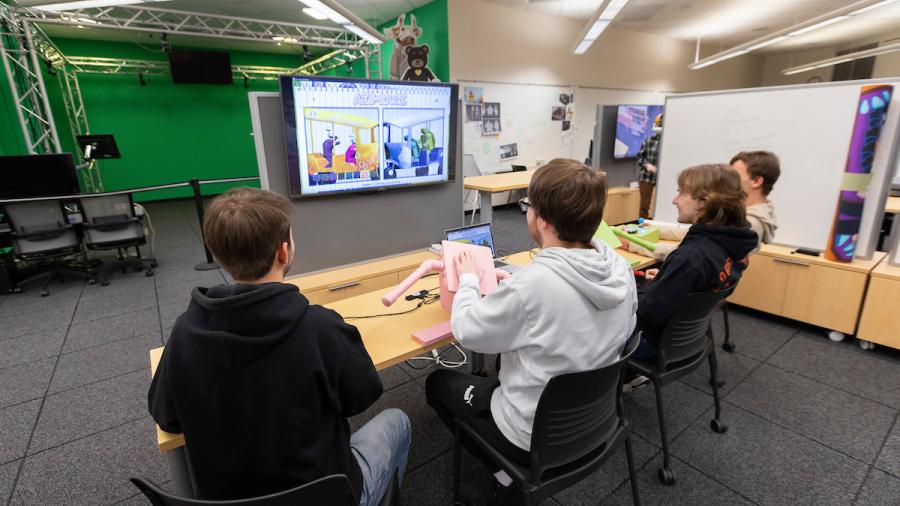
Two teams of two compete to complete three laps. Each team has a driver who steers, collects items, and performs tricks and drifts for speed boosters, while the saboteur places obstacles – like an exploding glue bottle – to hinder opponents and clear their own path. The game features custom controllers and takes place within five main levels – Funky Forest, Silly Swamp, Dizzy Desert, Whimsical Winter and Forest Mixed Tape.
Rogowski constructed the steering controllers at home – painted green for the tortoise team and pink for the rabbit team. They resemble bicycle handles, which turn via a caster swivel joint. A small sensor measures rotations processed by a microcontroller hidden beneath that updates player movements on screen.
Artists include Odessa Barreyro, who proposed the game idea, and KC Caron and Jess Haapoja. Programmers also include Jack Decker and Max Mike. The team collaborated on audio design with students at Berklee College of Music in Boston.
Hazard Hotel
The development of the Hazard Hotel controller was led by Zak Suhajda, whose role was interface design, electronics and programming. Spencer Betchey was one of the programmers assembling the scenes and programmed interactions among the team.
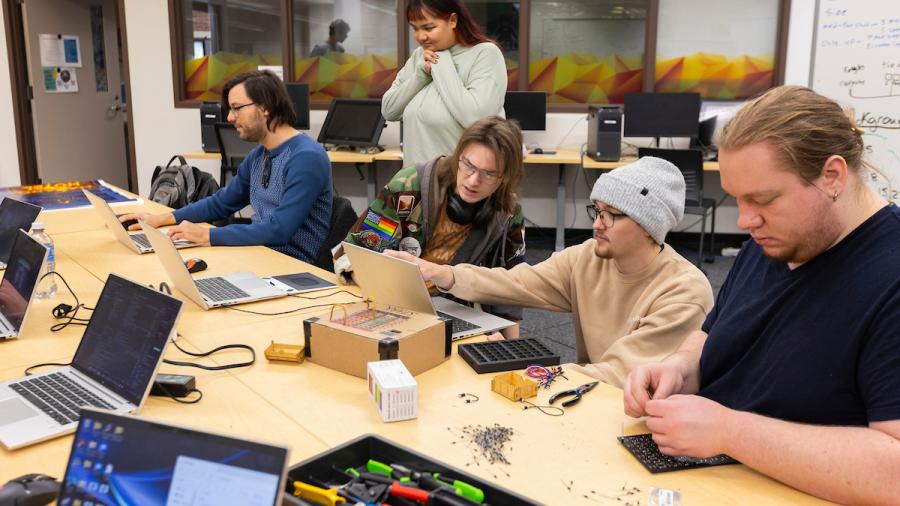
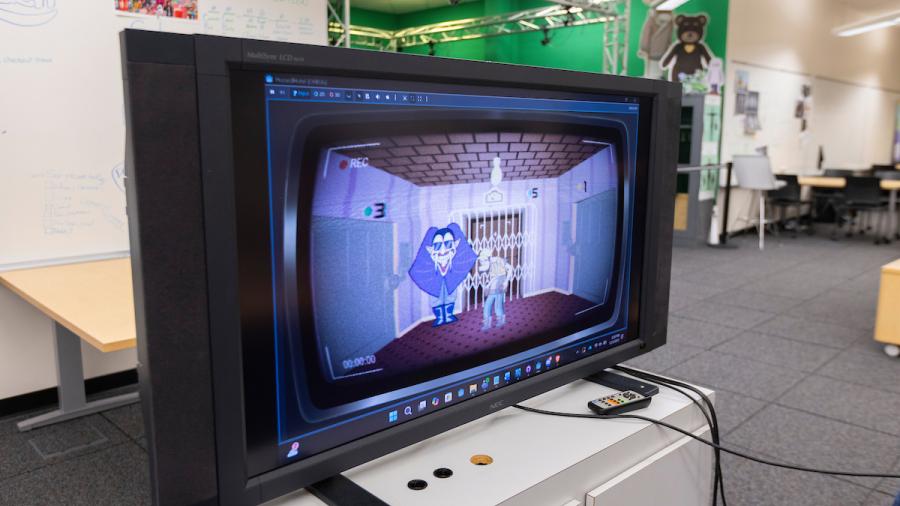
To repair the haunted Hazard Hotel, the player acts as “The New Guy,” using an electrical switchboard to divert power and activate machinery as they slowly work their way to the top of the hotel.
“What makes this game unique is that the interface resembles a wire switchboard – think of an old-time telephone operator – to power the doors, elevator, lights, etc., in the video game environment,” Koehle said.
Suhajda’s idea for the switchboard came about while working with Arduino controllers. “I wanted to create something simple, something that my dad would like to play,” he said.
Artists include Ben Musser, Antonio Garcia and Gregg Hammel, who created 2D and 3D art and puzzles. Programming was done by Donovan Hecimovich, Thomas Stolz and Sam Schreiter. The concept for the puzzle game was based on elements of four game ideas developed by the team earlier in the semester.
Retro Repair
Chloe Ferguson, an M.F.A. in design student, is the lead developer of the augmented reality experience, Retro Repair. The game focuses on the theme of “Right to Repair,” which gives consumers the legal right to freely maintain, repair, or modify their own products, such as automobiles, electronics and farm equipment, instead of having the original manufacturer provide repair service.
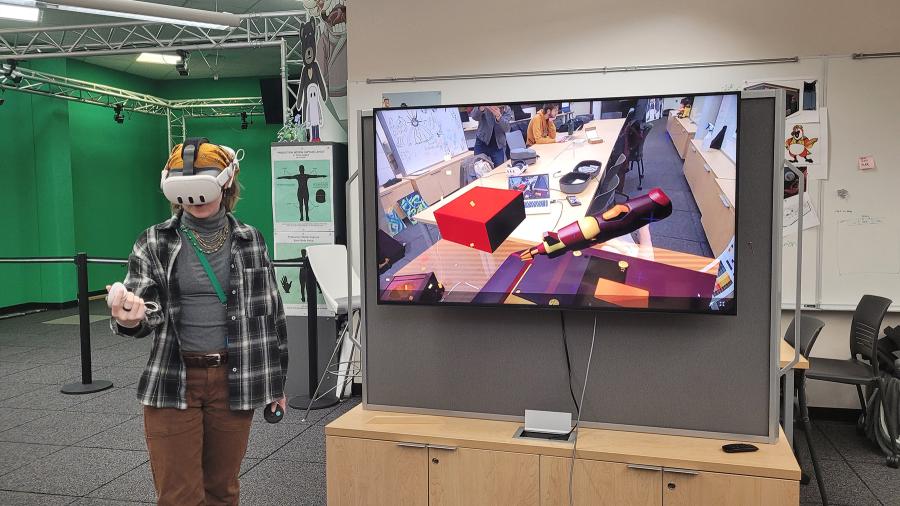
In this AR space, the player is a repair technician from the future, who uses tools to repair old, proprietary consoles. Tools at their disposal are a screwdriver, heat torch and wire cutters. They repair each console around the proprietary restrictions in their AR workshop.
Developers also include Connor Donnelly and Alex Lietha. The team mimicked the shape and feel of old consoles as well as an arcade-inspired color theme to give a nostalgic sense to their futuristic game.
“This is a collaborative process, a project based on teamwork,” Ferguson emphasized. “As a master’s in design student, I can concentrate on the artistic aspects, while working with Connor and Alex, who are more versed in programming.”
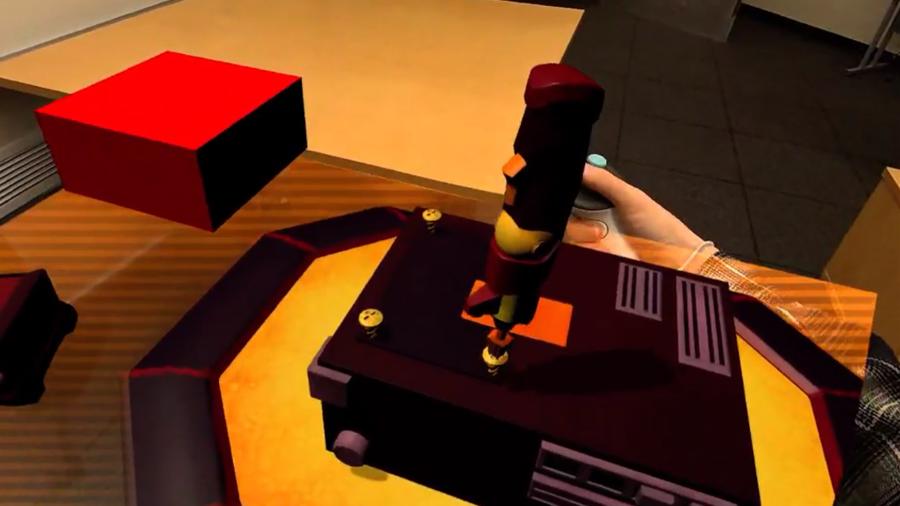
Ferguson and Donnelly have both participated in the “Right to Repair” in a sense. Ferguson enjoys the creative freedom of building custom desktop computers, and Donnelly has adapted consoles and charging ports to suit his preferences. “The frustration we felt with some devices helped inform our design of our game. We can help to make things more accessible,” Donnelly said.
Stars & Spurs developers include artists Sam Kiewel, Seth Shaw and Jackson Hinshaw. Programmers Kara Defoe, Andrew Jones, Jasper Knutson, Iris Parke and Onyx Severin.
Clean Break! developers include artists Justin Bonelli, Maddie Honaker, Madi Moseng and Ethan Skoog. Programmers are Jack Belcher, Alex Tlougan, Riley Gaetz, Devon Russin and Dani Matthiesen.
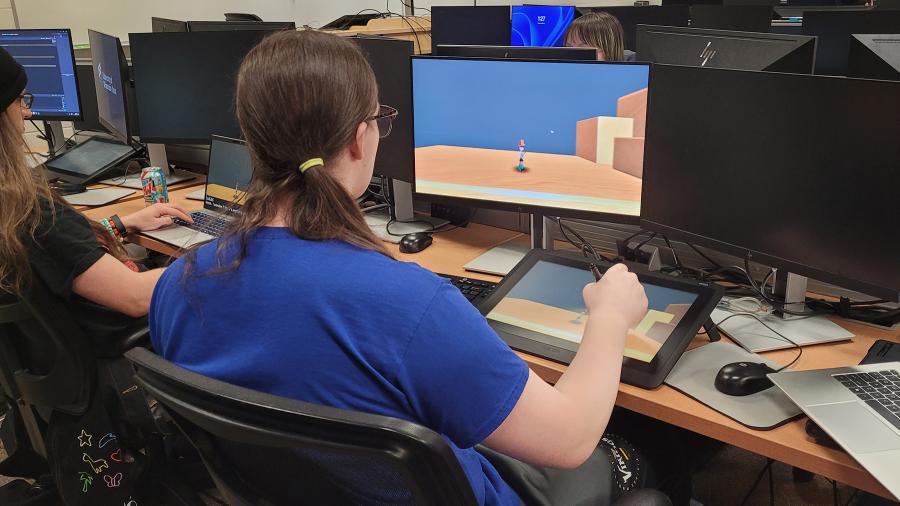
UW-Stout’s game design and animation lab spaces include a state-of-the-art Vicon Motion Capture Studio, along with many other labs, studios and galleries.
UW-Stout’s School of Art & Design is one of the largest public art schools in the Midwest. It offers bachelor’s degrees in animation and digital media; game design and development-art; graphic design and interactive media; illustration; industrial and product design; interior design; studio art; arts administration and entrepreneurship; fashion design and development; and video production, and an M.F.A. in design. UW-Stout also has a new program in game and media studies.