


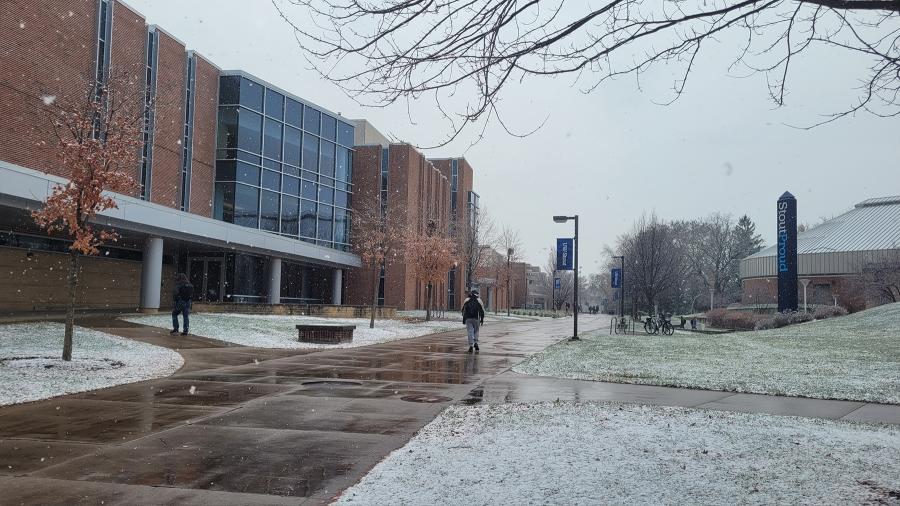
The first snowfall of the season blankets the grass and clings to pine boughs. Walking through campus, winter arrives early as the ground turns white.
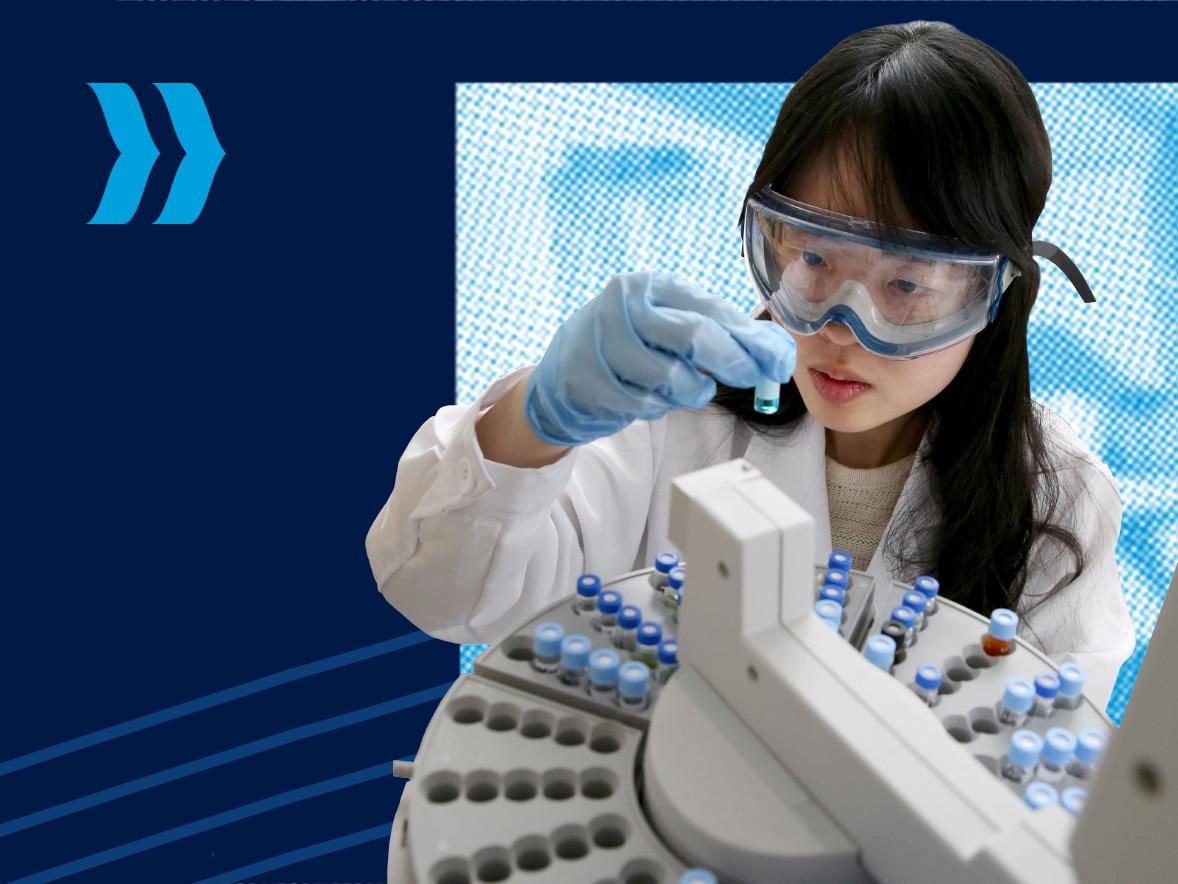
But inside a Jarvis Hall Science Wing chemistry lab, liquids turn vivid pinks and deep blues in beakers — a stark contrast to the scene outside. Clear flames ignite compounds and burn a sun-kissed orange hue. And the faint smells of ammonia, tropical-fruit-flavored antacids and roasted sugar waft through the air.
“What’s burning?” a classmate asks. Nothing to be alarmed about. It’s all part of the experimental process in Professor Marcia Miller Rodeberg’s College Chemistry Honors I course, as seven pairs of students conduct research in preparation for the STEMM Student Expo on Dec. 11.
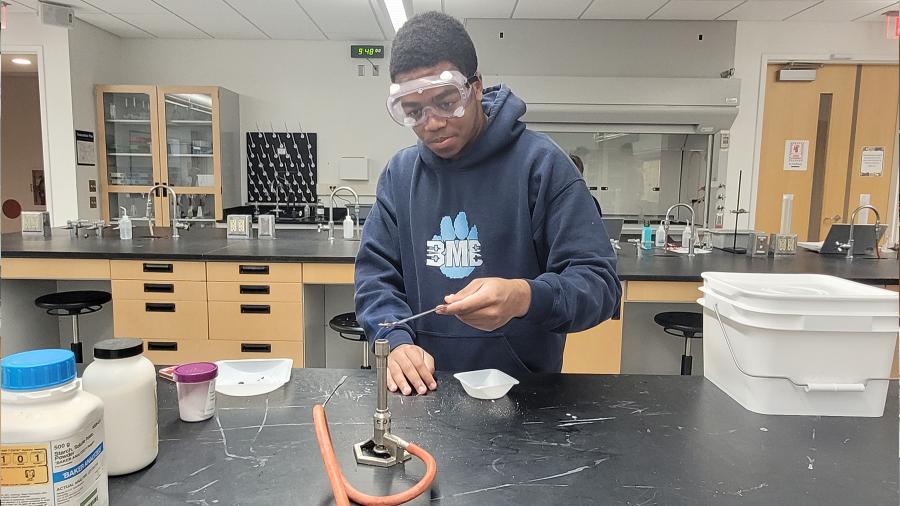
Students choose their projects based on their interests. The smell of roasted sugar stems from Hayden Weber and Erick Day’s lab station, where they’re just “Fuelin’ Around.” They use a deflagration spoon, or burning spoon, to hold small amounts of fructose, sucrose, starch and organic acids over a Bunsen burner flame, waiting for it to ignite.
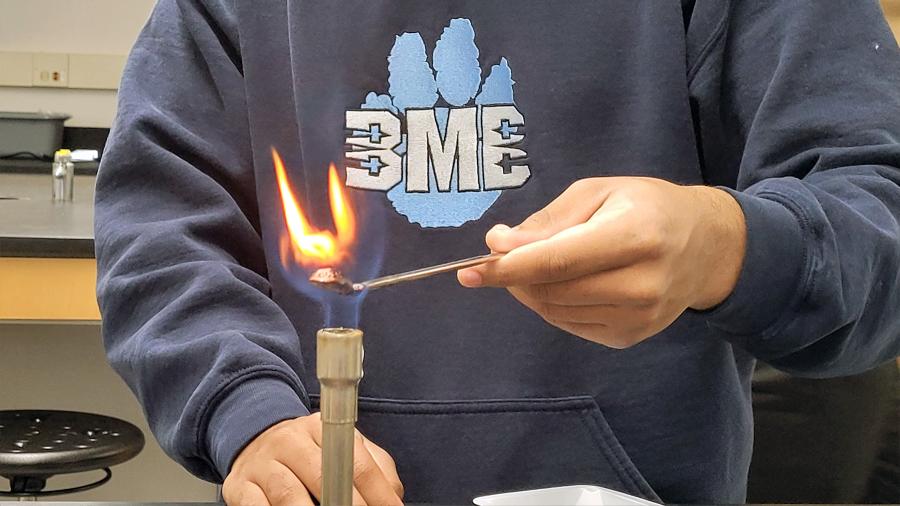
The sugar takes a bit to ignite, but once it does, the blue flame *pops* and a white and orange flame erupts above the spoon. They measure the carbon levels and combustion rates of each substance and find how much water is lost in the combustion process to determine the mass of carbon in each.
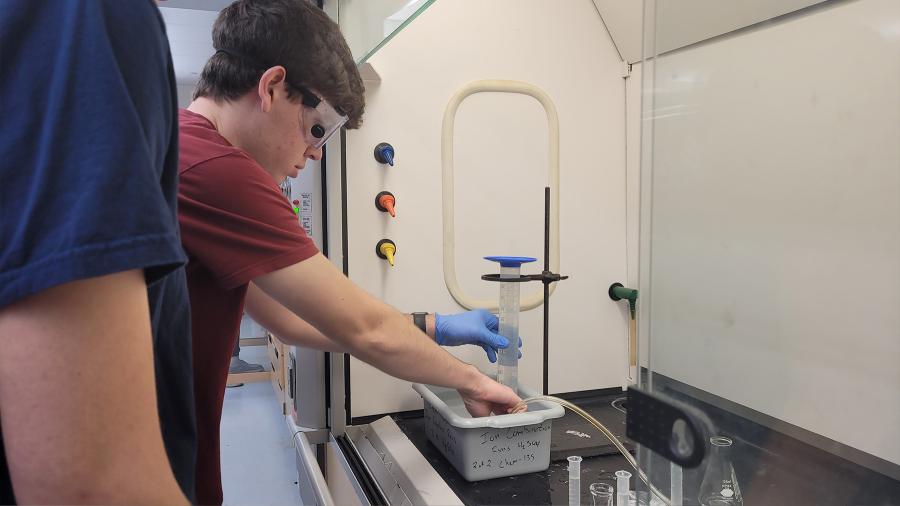
Griffin Boldt and Carson Stehr are curious about “Refilling the Hindenburg” and want to know how much helium it took to lift the massive zeppelin. They wonder what combination of metal, acid and acid concentration results in the largest rate of hydrogen production.
The Hindenburg was a German passenger zeppelin – the largest airship by volume of its time. It crashed and burned while landing on May 6, 1937, in New Jersey. The disaster, probably caused by a spark that ignited the hydrogen gas used to lift the craft, ended the era of rigid airship travel.
“Because of hydrogen’s explosive properties, you don’t get to interact with it every day,” said Boldt, of St. Paul. “I’ve always liked learning about history, so I thought it would be fun to see how much basic lab material we’d need to fill the Hindenburg.
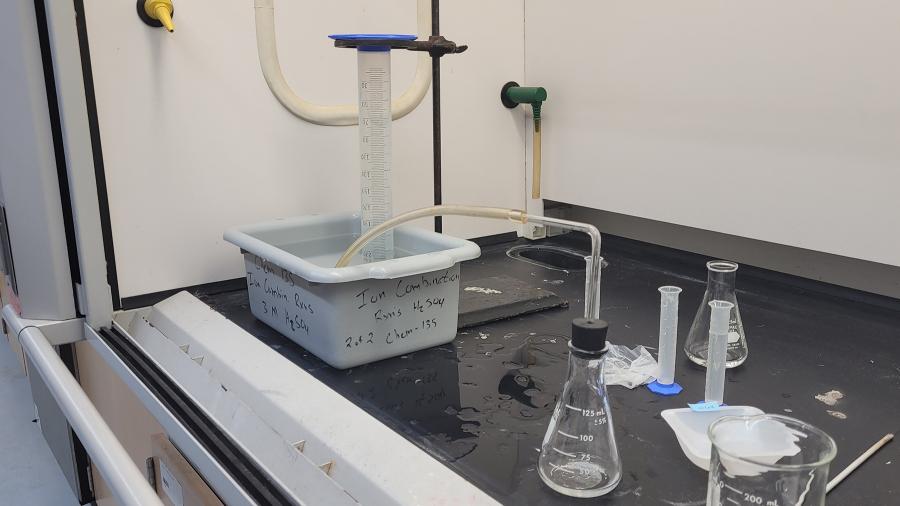
“We figured it would be a cool way to connect our data with a real-world scenario,” added Stehr, of Baldwin. “Finding the rate of hydrogen production alone is not necessarily the most interesting experiment. But calculating the conditions necessary to make a massive object lift off the ground is much more intriguing and provides our experiment with a little bit of scale.”
Using a fume hood for safety, the pair mix individual fragments of magnesium, calcium and zinc with hydrochloric acid to produce and measure different levels of hydrogen gas. As the mixture combines, bubbles rise through the liquid, producing gas as they break the surface. Boldt and Stehr predict that a higher concentration of hydrochloric acid combined with calcium will have the fastest production rate.
Chemistry interests Boldt and Stehr because it explains how the world works and shows how things are connected at a deeper level. “I have taken for granted that things just work, but chemistry opens up a new world of understanding. Chemistry plays a role in everyday life and helps me appreciate the intricacies that everything relies on at some level,” Stehr said.
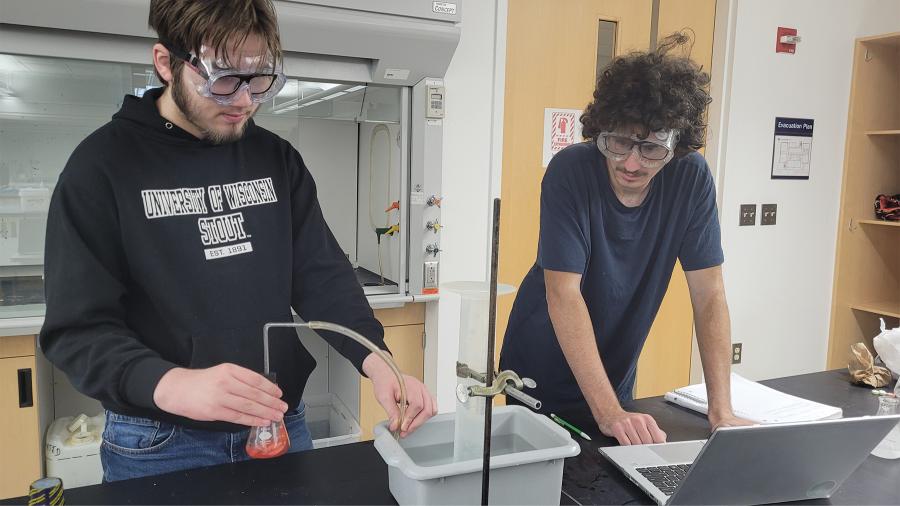
At another lab station, Elliot Harding and Camdin Lillesve are conducting a “Comparison of Gas Production by Commercial Antacids.” They measure the dissolving rate of the calcium carbonate levels in various antacid brands. They can determine which brands may relieve the feeling of indigestion most effectively.
Across the lab, Maddy Weiss and Reesi Williams are finding “The Sweetest Absorption” by measuring glucose levels in beverages, including orange juice, apple juice, an energy drink and coffee, while Natalie Schmit and Jadyn Swinehart measure the free fatty acid content in various kinds of salad dressing oils.
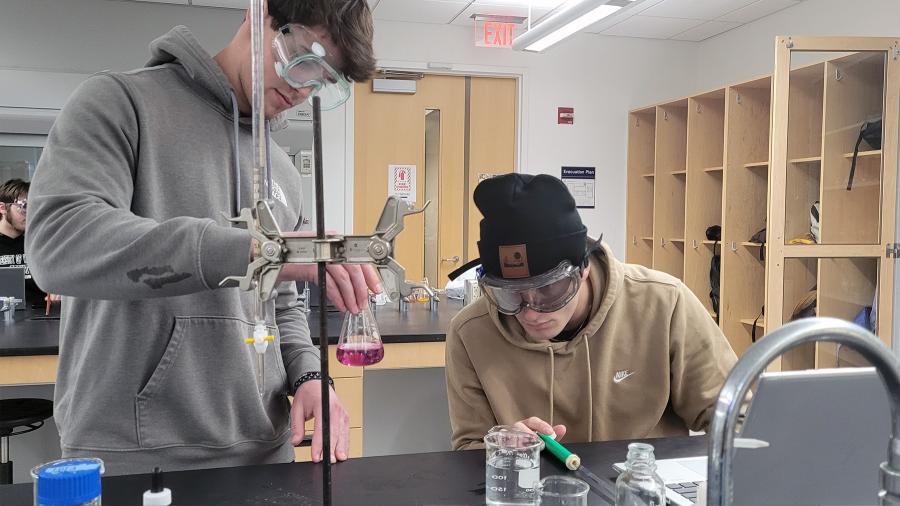
The salad dressings tested are pumpkin seed oil, peanut oil, olive oil, vegetable oil and Italian dressing. They use the titration method, adding a base of potassium phthalate to each oil, turning the solutions into different shades of pink. A lighter pink equals a lower concentration of free fatty acids, and the better quality of the oil.
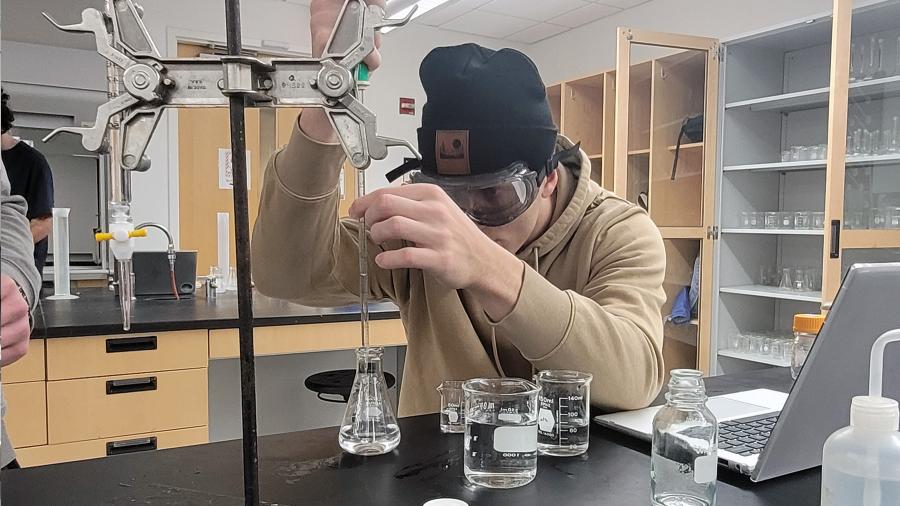
Grady Hatlestad and Gavin Staudacher are looking into the “Hard Facts about Campus Water.” They study seven samples of campus tap water to test the pH balance. Different calcium levels determine the hardness levels of the water samples. Using a solution of ammonium chloride and ammonium hydroxide, they first titrate deionized water as a control. The sample turns immediately blue, showing there is no calcium present.
However, a sample of water from the lab faucet turns pink, showing that calcium is present. The brighter the pink, the higher the level of calcium.
Cole Remiger and Chenue Thao are experimenting on “Tick Tock, It’s Iodine O’clock” by creating an iodine clock reaction, which illustrates the different rates at which chemical reactions occur: one that produces iodine and a second that consumes it.
Something has gone awry, however. The experiment is meant to result in a dramatic color change — from a colorless liquid to deep blue — upon reacting with starch. Instead, the liquid turned dark brown in color. The students think perhaps they didn’t boil the starch long enough on the hot plate, and the reaction failed — all part of the scientific process.
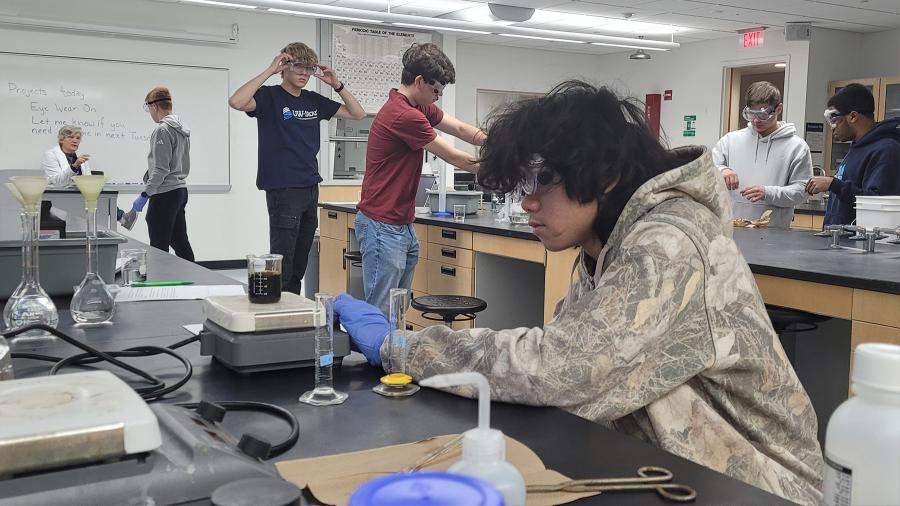
The STEMM Student Expo, along with Research Day, are two of UW-Stout’s College of Science, Technology, Engineering, Mathematics and Management’s biggest events of the year, showcasing hundreds of projects across more than a dozen fields of study. Research Day 2026 will be held on Tuesday, May 5, 2026.
Boldt and Stehr, who are computer and electrical engineering students, encourage others to participate in STEMM Student Expo and Research Day because the events give students the “opportunity to dive into a topic to be invested in and learn more about it. Instead of doing one lab experiment and moving on, you get to slow down a little and learn more about a topic that interests you. It is one of the best ways to understand and build off that topic,” Stehr said.
“There are so many cool projects and topics at the STEMM Expo, and you never know what you might find. You might be inspired to find a topic of your own to research or discover something interesting to learn more about,” Stehr added.
Boldt encourages community members and industry professionals to attend the events because “it’s a great opportunity to better know the students living in their community and to find future employees. It’s much better to meet with somebody face-to-face instead of scrolling through endless resumes,” he said.