





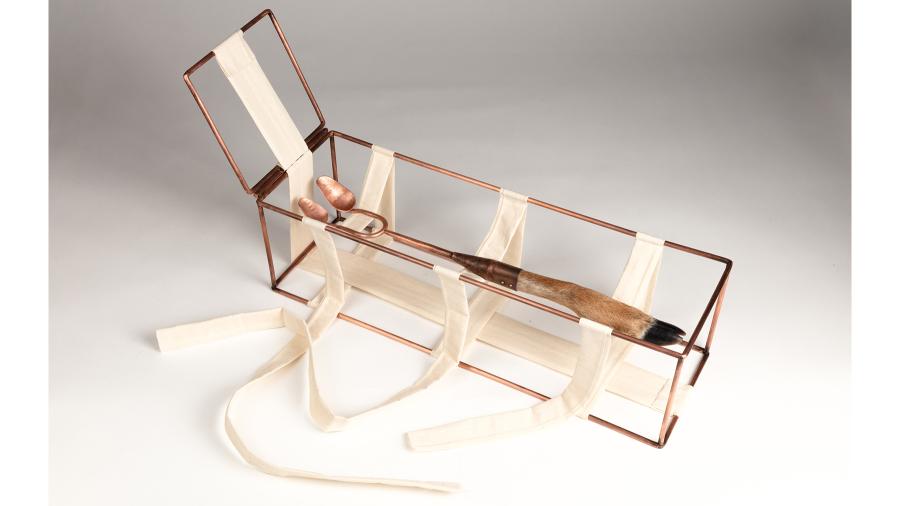
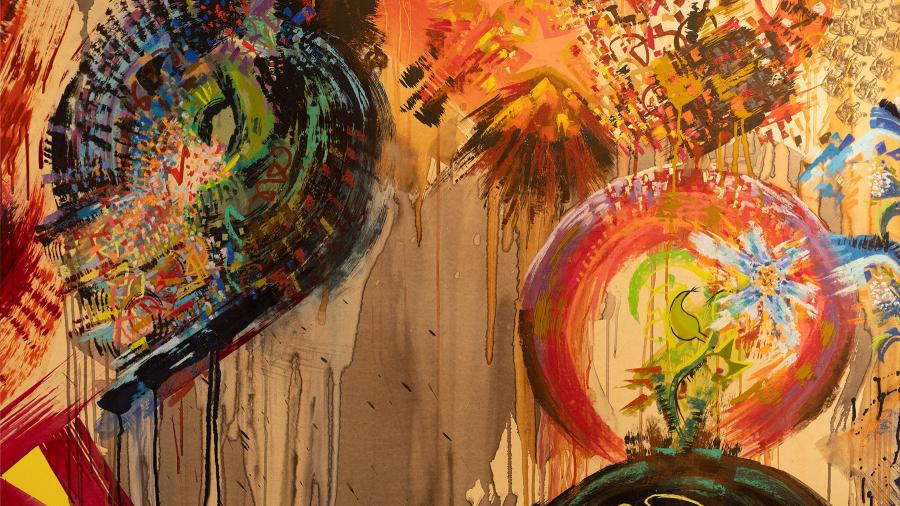
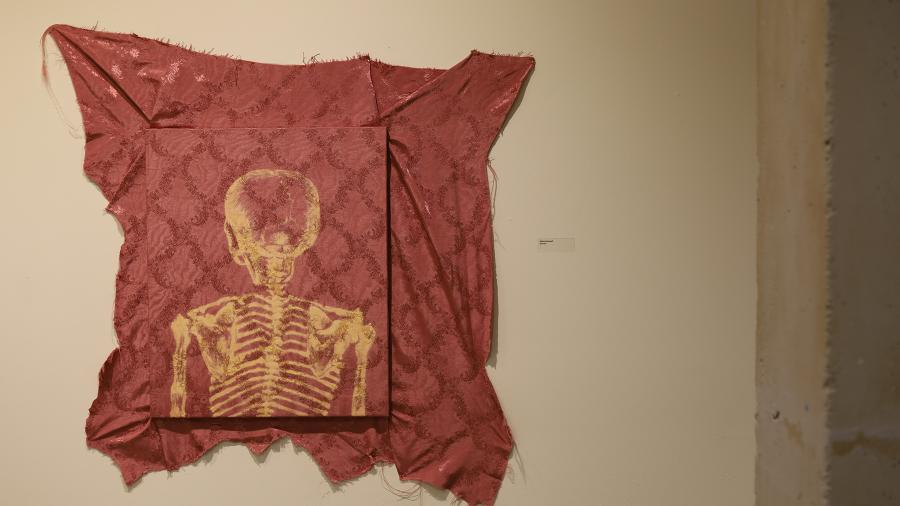
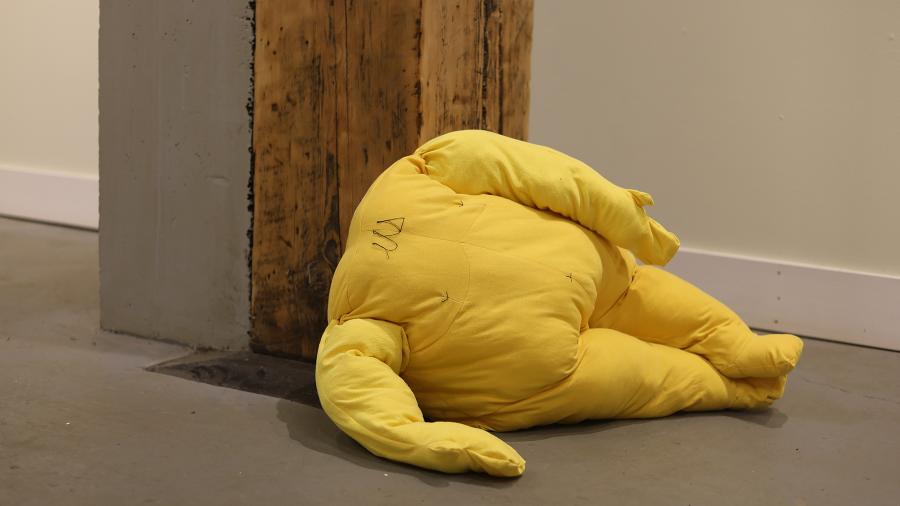
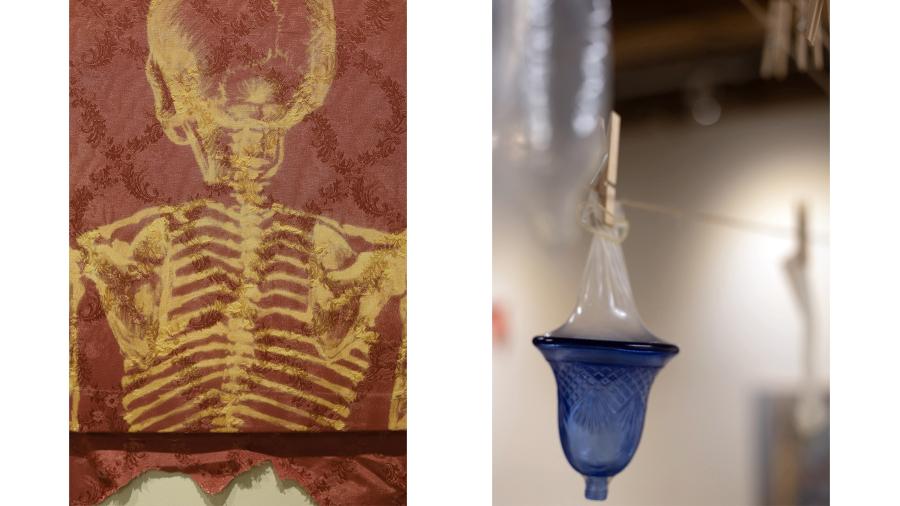
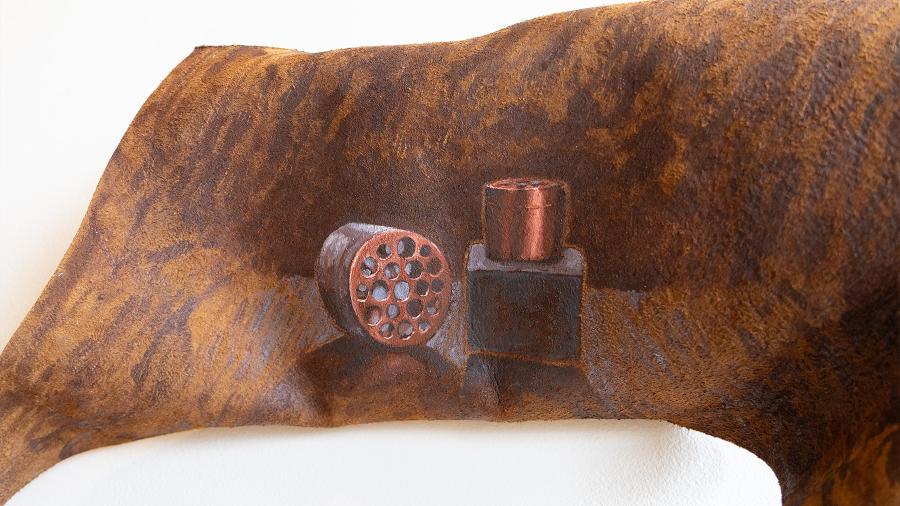
Cradled in straps of pale linen, supported by a copper-piping frame, rests a foot-long double-headed spoon, forged and fastened to the lower portion of a white-tailed deer leg and hoof. Around the corner, adhered to the gallery wall, are rune-like letterings created with tape – shapes that seem so familiar, yet so alien. And the posterior view of a skeleton painted with bleach is stretched across richly textured mauve fabric near the slumped figure of a soft, headless man-like 3D creature.
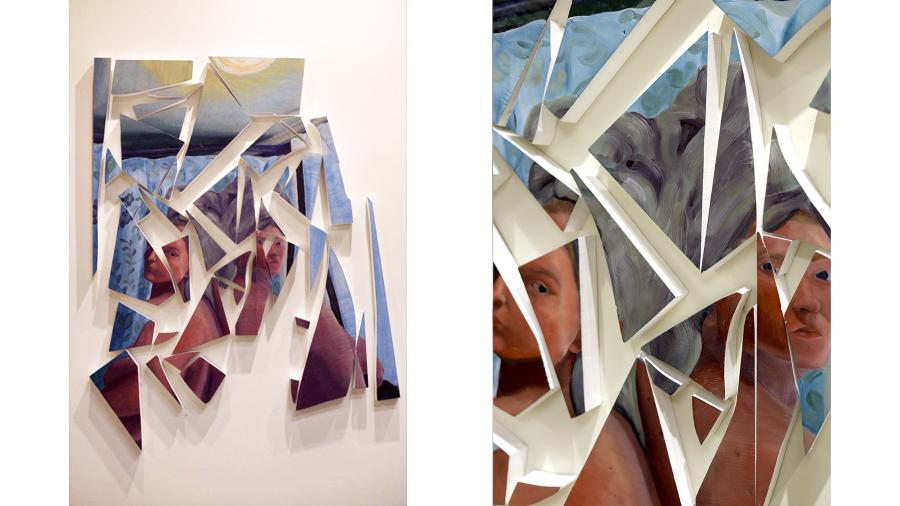
For two weeks this summer, 46 emerging artists in UW-Stout Polytechnic’s School of Art & Design took over three floors of the Q.arma Building in Minneapolis for “Fieldwork,” a curated exhibition featuring 57 works of art spanning painting, drawing, sculpture, printmaking, comics, photography, ceramics and metals.
“The top-to-bottom ‘Fieldwork’ exhibit at Q.arma was a unique opportunity for our students to come together,” said Senior Lecturer Darren Tesar, program director of B.F.A. studio art and B.S. arts administration and entrepreneurship. “It showed that our studio art program and the School of Art & Design is a leading institution of contemporary art. We are not bound by dogma or tradition. It’s important for people to see our students’ full range and complexity.”
Selected works from “Fieldwork” will be on display through October at the university’s Library Art Lab, on the first floor of the Robert S. Swanson Library & Learning Center.
Engaging in every aspect of an exhibition
Alongside faculty, recent B.F.A. studio art graduates Ashley Hannasch and Xander McFaul helped install “Fieldwork.” They thought the Q.arma experience was a unique opportunity to engage in every aspect of an exhibition in a setting outside of the university – from transportation to curating to installation and final gallery preparations.
McFaul, of St. Paul, whose pieces in the show were “Pink, Pink, Pink, Pink, Pink Moon” and “This Is Our Last Song,” said, “This is significant on my resume and opens the door to more Twin Cities opportunities in my future. I encourage students to apply to as many of these opportunities as possible, as well as start curating their own shows in their own spaces and communities.”
Hannasch, of Lakeville, Minnesota, agreed. “Working alongside faculty and students strengthened my confidence in exhibition planning and gave me a deeper understanding of the collaborative nature of working in a gallery,” she said. “I encourage current students to seek opportunities both within and beyond the university, trust their instincts, and build relationships with fellow artists.”
Hannasch, whose exhibit piece was “Spineless,” noted, “I believe artists grow strongest when we communicate, collaborate and support one another as a community.”
Two current students, Travis Bennett and Cora Kauffman, think “Fieldwork” was a great opportunity to showcase their work to a bigger audience outside of campus.
“It helped me understand how my work exists within a larger gallery space and gave me more experience for future exhibitions,” said Bennett, a fashion design and development and studio art major, concentrating in metals and contemporary art jewelry.
Bennett, of Hager City, creates artwork with a Midwestern-Gothic flair, inspired by his material-based investigation of the relationship between the body, animals and objects of utility. His piece in “Fieldwork” was titled “Untitled (Dining Object No. 1).”
“Growing up in the rural Midwest has influenced my work a lot. I thought about the way we harvest our food, and I wanted to transform a deer's foot, something that is a byproduct of hunting, into a utensil and case that feels both functional and uncomfortable,” he said.
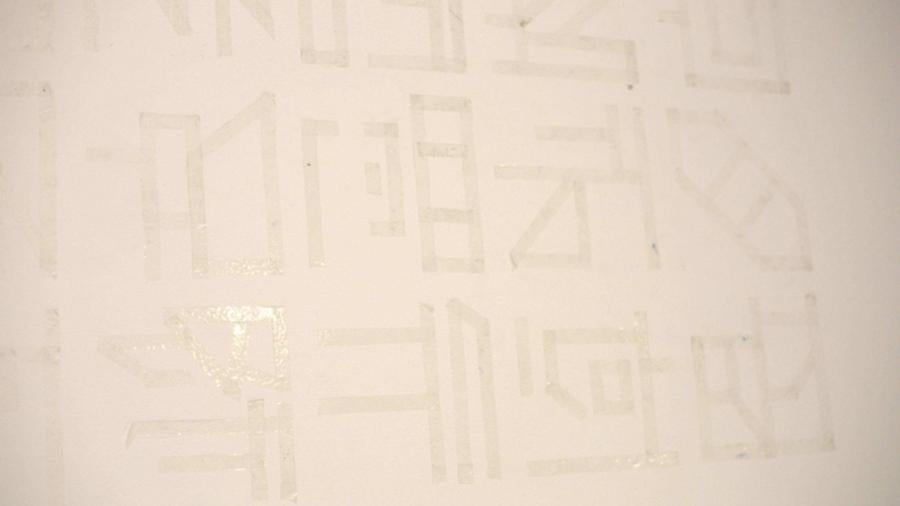
Kauffman is inspired by forms of language. “After my semester abroad in Japan, I knew I had to continue this line of work. I thought about the forms present in the written Japanese language and how to create something that invokes these forms while remaining as ephemeral as spoken language is,” she said. Her “Fieldwork” piece, “Before you even know it,” consisted of several site-specific installations of rune-like letters.
Kauffman, a studio art major from Chippewa Falls, was awarded a solo thesis show at the university’s Gallery 209 this fall. “This experience was a great opportunity for me to learn how an exhibition is organized and installed. I was also able to learn how to manage my time as I installed my piece in the gallery,” she said.
Collaborations to create trajectory
“Fieldwork” emphasized the university’s commitment to preparing students for professional careers in the arts, highlighting the making, collaboration, curation, installation and professional practices that shape contemporary artists.
The exhibit included a juried collection by intermediate and advanced studio art courses, an independently organized exhibit by the student-run Fine Arts Association, and a series of pop-up presentations and sales by the Print Club, Comix Club, Metals Guild and more.
Tesar and Professor Alex DeArmond knew Q.arma had a history of exhibiting emerging artists’ works. “Owner Jono Query has a passion for providing art spaces to students, knowing how difficult opportunities can be after graduation. We wanted to create a connection. Studio art seemed to be the best vehicle for an exhibit,” Tesar said. “If we’re going to show our strength as part of the university, we need to show our work professionally in spaces like Q.arma. We need to provide access and opportunities outside of our campus for our students and create a trajectory for them for after graduation.”
After the exhibition, which was held June 6-21, Tesar and other faculty realized how much students want more external professional, collaborative and entrepreneurial experiences.
“There’s only so much that an in-class curriculum can do. The experience allowed us to fill a gap that we can’t provide in the classroom – for the students to see how art plays out across a wide range of organizational models. The collaboration between Stout and Q.arma provided access for students to see and act with economy and culture in the private sector,” Tesar said.
“Every single student could put on an exhibition. Younger students need to learn that they can’t just follow; they have to create these opportunities for themselves as well. And we need to help them recognize it takes a collection of people to make these possibilities happen,” they said. “Creating the experiences gives students that confidence – it gives them the know-how. They become aware of the nuance and simplicity of making things happen professionally.”
UW-Stout Polytechnic’s School of Art and Design, one of the largest public art schools in the Midwest, offers bachelor’s degrees in animation and digital media; game design and development-art; graphic design and interactive media; illustration; industrial and product design; interior design; studio art; arts administration and entrepreneurship; fashion design and development; and video production, and an M.F.A. in design.