





Nothing draws a hungry crowd quite like the aroma of freshly baked bread, the flaky deliciousness of croissants, the mouthwatering perfection of pastries. At Edgewood Bakeshop, owner Bekah Stamps welcomes daily crowds, as patrons form a line out the door of her popular artisanal bakeshop in downtown Chetek.
But how does an already successful business improve its operations and increase sales? For Stamps, the answer came in a collaboration with UW-Stout business administration students.
Recently, students in Lecturer Kayla Stajkovic’s Cost Accounting course used Edgewood Bakeshop’s real cost, sales and operations data to analyze break-even points, product decisions and seasonal sales patterns. At the end of the project, they presented their recommendations to Stamps.
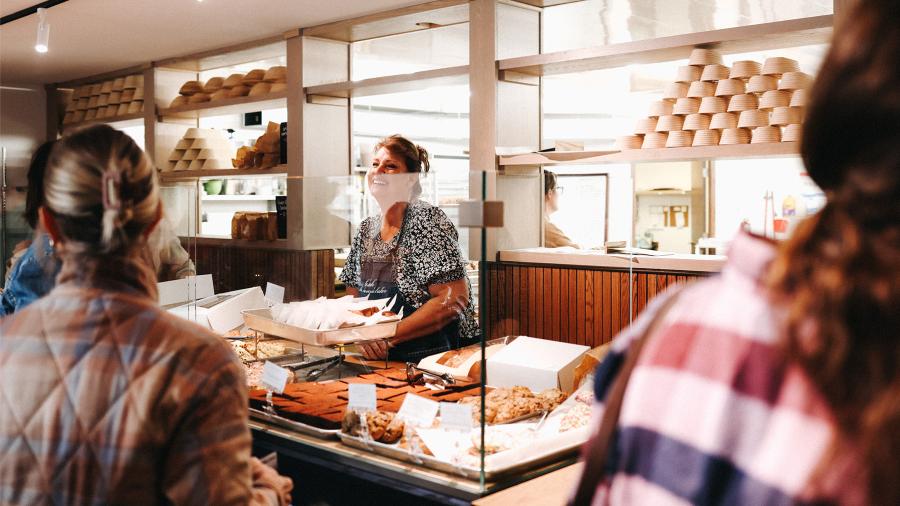
“I was impressed with the level of professionalism I witnessed from the students in this class,” Stamps said. “There were multiple moments where I felt that I was sitting with an accounting firm I’d hired to deep dive into my business. These students have a bright future, and I’m honored to have been able to collaborate with them in this way.”
Stajkovic thinks small businesses are uniquely powerful learning partners because their challenges are visible, immediate and consequential. “When students work with small businesses, they see firsthand how interconnected decisions are. Small businesses — especially newer ones — are often operating with limited resources while the owner wears every hat: operations, marketing, finance, HR,” she said.
Using cost accounting as a strategic decision tool
At the start of the project, Stamps visited the class, shared her background, her vision for Edgewood Bakeshop and her belief that bread was her primary profit driver.

However, the students’ analysis proved that what looks most profitable on a simple revenue-minus-cost basis isn’t always the most profitable when constraints are considered. When they calculated contribution margin per oven minute and per labor hour, instead of just per unit, they discovered that croissants could outperform bread depending on which resource was the true bottleneck.
“That shift from ‘Which product makes more money?’ to ‘Which product makes the best use of our limited resource?’ was transformational for the students. It moved cost accounting from a formula-based approach to a strategic decision-making tool. Several students commented that this was the moment when accounting stopped feeling procedural and started feeling managerial,” Stajkovic said.
This was also a standout moment for Stamps, who had done a brief analysis of unit cost and profit margin on a couple of her products when she began. “My assumption about the bread was actually incorrect, and it caused me to think about ways to drive more sales with certain products that I wasn’t previously considering,” she said.
‘Exactly what experiential learning is meant to do’
The Office of Corporate Relations & Economic Engagement serves to connect organizations and entrepreneurs with UW-Stout’s talent, tools and technology. Those seeking consultation and collaboration may reach out to OCREE with questions.
These collaborations distinguish UW-Stout students’ applied, experiential learning from a traditional education, as they give back to the community and fuel their careers with real-world experience before graduation.
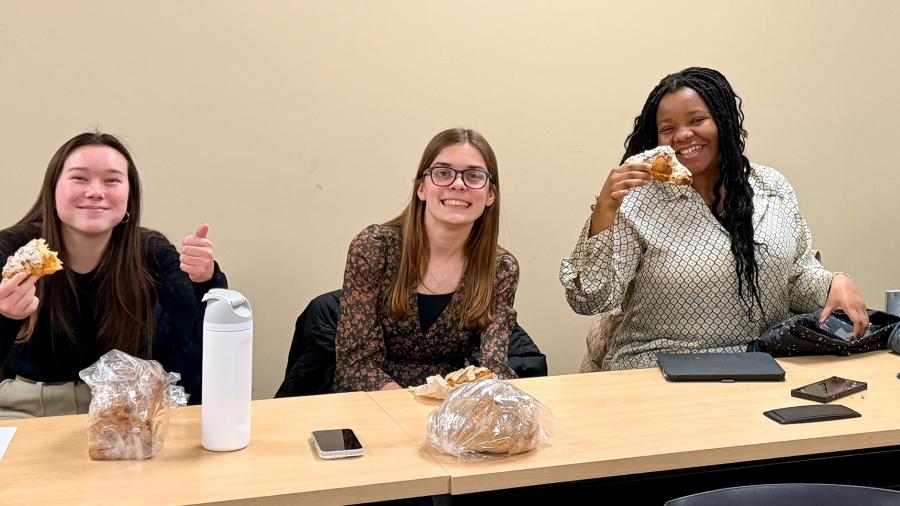
One of the most meaningful parts of this project for Stajkovic was watching students gain confidence. “Many began the semester unsure about cost accounting. By the end, they were defending recommendations to a real business owner using data they had analyzed themselves. That growth — from uncertainty to ownership — is exactly what experiential learning is meant to do,” she said.
Business administration senior Emanuel Sanchez, of St. Paul, was surprised by the confidence he gained. “This project changed how I approach business problems by shifting my focus away from finding a single ‘correct’ answer to making informed decisions with incomplete information. I strengthened my analytical skills, particularly in applying accounting tools to real-world situations and clearly explaining financial results,” he said.
Business administration junior Allison Lindner, of Stratford, thinks the project reinforced the idea that business decisions and analysis are not all about correct calculations and costs, but rather communication, informed judgment and thinking beyond the box.
“Overall, it has furthered my collaborative skills, ability to ask open-ended questions and assumptions, and understanding of the numbers in real operational challenges,” she said.
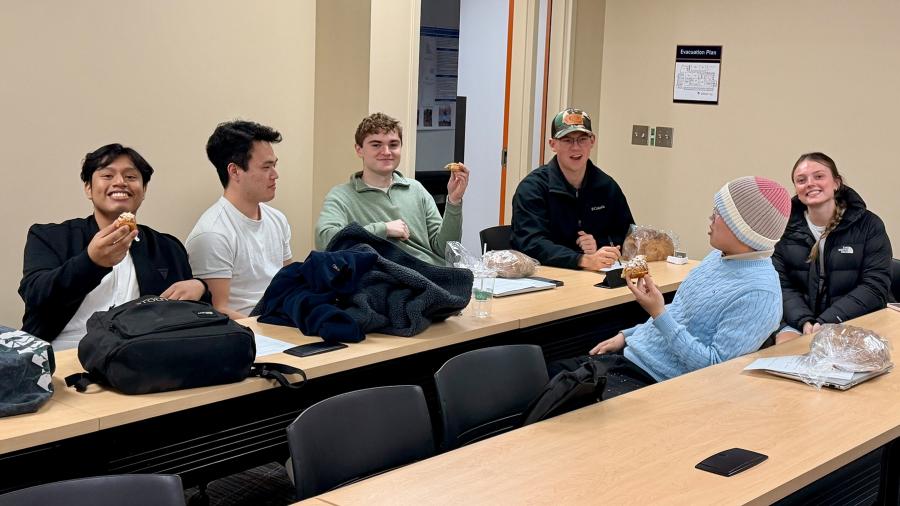
The students saw how messy real data can be, which is something no textbook can fully teach. “The experience changes how the students view their education. They began to understand that the numbers they learned in class can directly impact someone’s livelihood,” Stajkovic said. “For the business, even one useful insight can be meaningful. Those partnerships may be smaller in scale, but they are incredibly high in impact — for both sides.”
For Stamps, it was a fun, informative and mutually beneficial project. “It would be interesting to revisit some of these calculations in two or three years when Edgewood Bakeshop is further established to see what’s shifted and how the business has grown,” she said, adding that giving students interested in becoming business owners a “day in the life” might also be insightful for future business classes.
UW-Stout’s School of Management offers 20 undergraduate and graduate degrees and certificates that build students’ leadership skills in business, hospitality and technology innovation, military science, and operations and management fields.