





John Mueller’s career has been defined by curiosity, adaptability and a knack for seeing the next big shift before it arrives. His work has influenced technology used by millions worldwide.
One of those shifts emerged in the late 1990s, when cellphones and personal digital assistants (PDAs) were common, but carrying two devices was inconvenient. At BSQUARE, a Microsoft contractor focused on the company’s mobile operating system and embedded devices, Mueller sold one of the first smartphones to Sagem in France and co-led development of early smartphones and other embedded technologies still in use today. He later played a key role at General Software, where foundational system software supported systems critical to companies like Google and aircraft produced by Boeing. His time at BSQUARE also highlighted how disruptive technologies are not always immediately embraced: Mueller remembers when Starbucks told the company it had no interest in using Wi-Fi in its stores.
Reflecting on these experiences, he says: “In high-tech sales working with companies that are pushing the edge of technology, we needed to remind ourselves that we don’t know what we don’t know—this has never been done before. It’s a gravitational force affecting the business.” That mindset of embracing the unknown and connecting people with opportunity became a hallmark of his career.
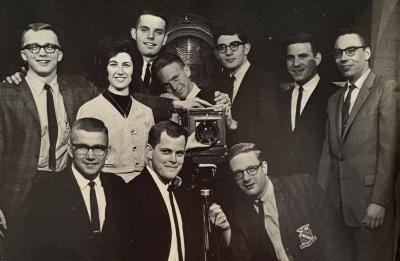
Mueller's path to global impact began in Neenah, Wisconsin, where he spent his youth tinkering in his uncle’s auto shop. Encouraged by his uncle, a neighbor who taught shop classes and supportive teachers, he developed a foundation in hands-on problem-solving that would carry him through multiple industry reinventions. That hands-on mindset reflects how he has approached his entire career. “The people coming out of Stout don’t want to talk and read about things, they want to do things,” Mueller says. “Polytechnic schools, this is their time to shine.”
After earning a degree in technology education from UW-Stout, he began teaching high school but was soon drawn to the technological shifts reshaping the printing industry. He went to work at 3M’s printing products division, where he built expertise in sales and business strategy and gained what he describes as a priceless business education over 16 years.
When digital imaging began to disrupt the industry, he saw the potential for innovation. That mindset carried him through reinventions at Scitex, where he entered the world of computer hardware and software as the company pioneered digital imaging and experienced rapid growth before being disrupted by emerging desktop tools. Mueller brought that perspective to Intergraph and beyond. At Intergraph, he was part of the team helping bring affordable Windows New Technology workstations to market alongside Microsoft and Intel, technology that outperformed higher-cost UNIX systems, commonly used for advanced engineering work, expanded access to advanced 3D design tools and changed the world of engineering.
His ability to navigate industries in flux, spot opportunity and push technological boundaries led to contributions that reshaped communication and computing worldwide. He also emphasizes the importance of understanding the bigger picture: “Students should be asking, ‘What do I need to know about this business to be successful? How does this business work? Where is this business going?’”
Mueller measures success not just in products, but in impact. From conversations with global technology leaders to connecting engineers, companies and ideas, his work helped bring transformative innovations to life. “We knew the things we were doing would change the world,” he says, “but we were so busy making it happen that we didn’t have the time or inclination to celebrate it.”
Throughout his career, he has prioritized mentoring the next generation. While at 3M and Scitex, Mueller regularly spoke with UW-Stout students about emerging industries, career paths and the importance of seeing beyond a single role. His advice: move to where the opportunities are; build a career, not a job; embrace change; take intelligent risks; create value and love what you do.
For Mueller, the lasting impact of his work lies not just in the technologies he helped advance, but in the ripple effect of ideas and innovation. From early smartphones to critical software infrastructure, his career reflects how curiosity, adaptability and a Stout education can shape the world.