





n a lab at University of Wisconsin-Stout, students in a mechatronics class presented their final projects as the fall semester wrapped up in late December. The event could have doubled as an inventors’ fair.
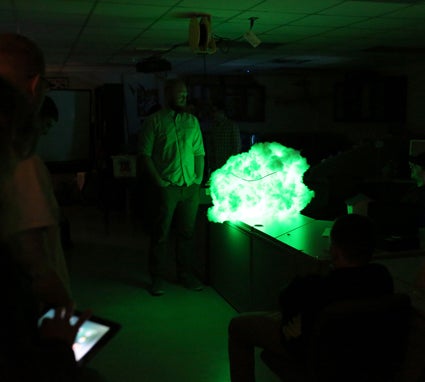
William Hibbard, of Appleton, explained his creation of what appeared to be a miniature cumulus cloud, an irregular-shaped mass of pillow filling. With a 15-foot strip of LED lights affixed to a wire frame inside, the cloud was programmed to glow in a variety of colors — something children might love in a bedroom.
Tyson Rohrscheib, of Eleva, and Matt LeBrun, of Wausau, explained their automatic greenhouse.
 In a plastic storage bin with a layer of dirt, they grew grass in two days. A watering system, light and fan were programmed to operate together around the clock and did all the work, once the seed was planted. A sensor let the watering device know when the soil was dry. Vegetables could be grown indoors in the winter, for example, with such a device.
Anna Stamschror, of Milwaukee, designed a bird feeder that she affectionately referred to as a squirrel launcher. When a squirrel gets too close to the food, a sensor is triggered, ejecting the squirrel.
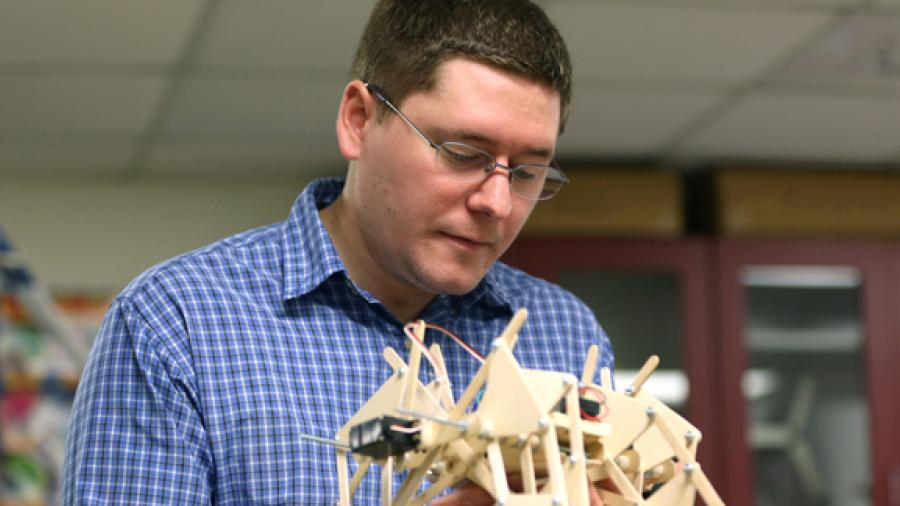
A shoebox-size “scrawler” made by Matthew Harris, of Antigo, walks on 12 legs using a twin cam system. Blending mechanical and electrical design, it can be controlled via Bluetooth technology.
Instructor Kevin Dietsche’s class challenged students to combine various aspects of engineering, including mechanical, electrical, computer, telecommunications and systems, and then to make something consumers might find useful.
“The application is across the board. I was impressed with their projects,” Dietsche said. “As a teacher, it’s fun to see them come through.”
Students in the class are majoring in technology education and in engineering technology.
Ice fishing made easy
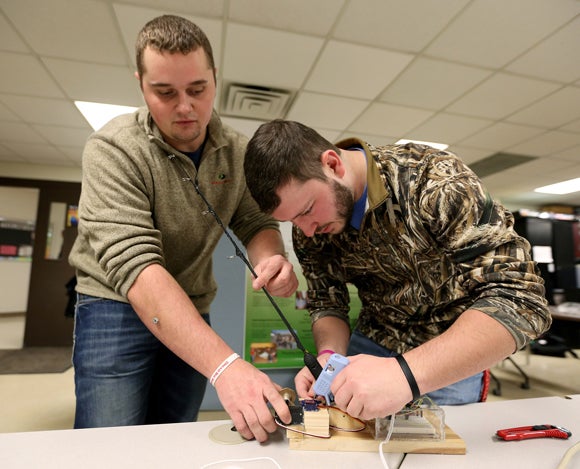
Two of the technology education majors, Drew Merryfield, of Little Chute, and Bryan Lammers, of Oostburg, invented something that many Wisconsin and Minnesota residents might find valuable in the winter — an automatic ice fishing rod and reel.
With a small motor connected to the rod and a sensor on the tip, they programmed the pole to jig — or quickly lift the bait — every few seconds to help attract fish.
That’s not all. When a fish is hooked and pulls the rod tip down, the rod senses the extra pressure and automatically reels in the fish. The device is rigged to catch fish up to five pounds, but they could design it for heavier fish.
The device can be controlled through a smart phone.
Lammers said the biggest challenge was wiring the pole flex sensor and getting it to work properly.
Merryfield loved the class. “We had the freedom to build what we wanted, and everyone in class helped each other. Professor Dietsche pushed us in the programming aspect and trying new things,” Merryfield said.
Merryfield and Lammers, both scheduled to graduate in December 2018, said they weren’t aware of any other automatic ice fishing pole on the market. They were planning to give it a try on the ice this winter but more importantly are excited to teach these skills in electronics, wiring and other areas to high school students when they graduate.
“The class teaches you the relationship between programming and electronics and how you make a mechanical system work,” Lammers said.
###
Photos
Top: Instructor Kevin Dietsche examines a mechanical-electrical “scrawler,” a 12-legged walking device created by Matthew Harris.
Second: Student William Hibbard explains his project, a “cloud” wired and programmed to change colors.
Bottom: Drew Merryfield, left, and Bryan Lammers set up their ice fishing invention, a pole that automatically jigs for fish and reels them in.