




Inspiring Graduate: Michi Marks (’26)
- Hometown: Menomonie
- Degree: M.S. Marriage and Family Therapy
- Sex Therapy Certification
Michi Marks immigrated to the United States from Thailand when they were three months old. Their birth name, Mai Cha, carried the hopes and dreams of a new life their family envisioned after escaping the Secret War in Southeast Asia. Their family eventually settled in Menomonie.
Growing up, Marks was often told that education was the pathway out of poverty. What they discovered over time is that education can be something much deeper, a way of understanding themselves.
They originally came to UW-Stout as an undergraduate to study hotel, restaurant and tourism management. But as part of the Honors Program, they were required to take a human development and family studies course.
“That class changed everything. It gave me language for the human condition. It helped me understand people, relationships and systems in ways that felt deeply meaningful,” Marks said. “It also helped me understand myself better. I switched majors the following semester, and that desire to understand the human condition has continued to guide my path ever since.”
Marks earned a degree as a McNair Scholar, graduating cum laude through the Honors Program in 2011 with a major in human development and family studies and a minor in English writing.
After years of working in corporate America, climbing the corporate ladder, while starting an art and home décor business, and later building a coaching and peer-support practice, an unexpected furlough was a turning point in their career.
“This unexpected pause gave me an opportunity to pursue a dream that had quietly lived within me for more than a decade: becoming a relational and systemic therapist,” Marks said. “I often imagined that if they ever returned to Stout, it would be to pursue a graduate degree in marriage and family therapy, inspired by a professor who still teaches there today.
“Education has the ability to change lives, though not always in expected ways. For me, UW-Stout has been a place where curiosity, community and courage merged. It provided the skills to develop a career and created a space to grow into a fuller version of myself,” they said.
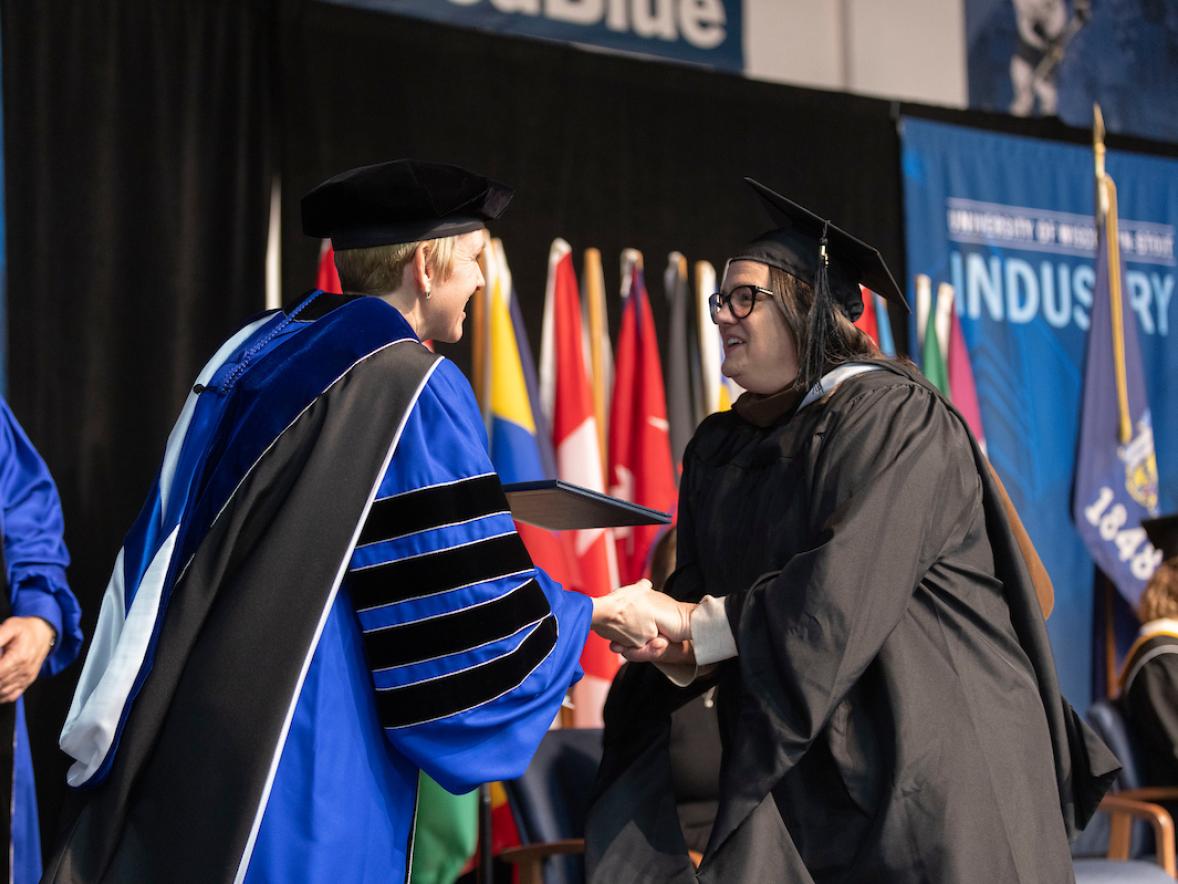
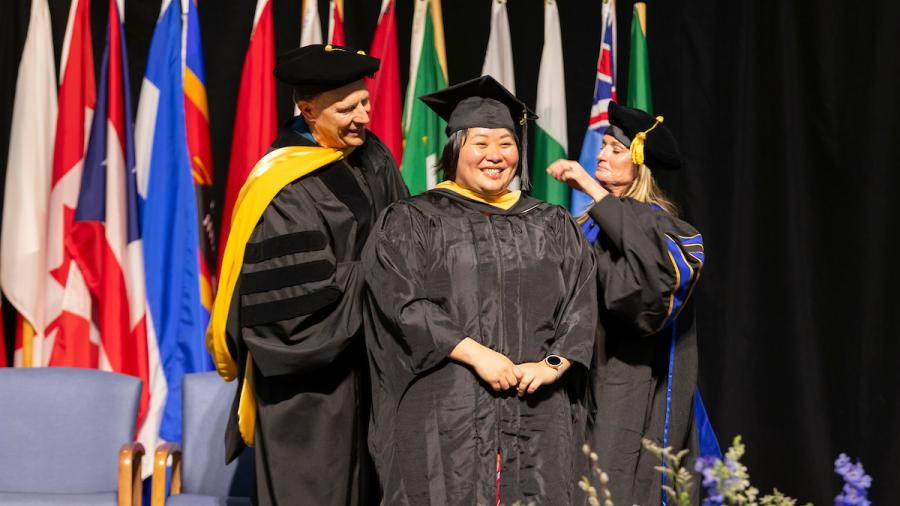
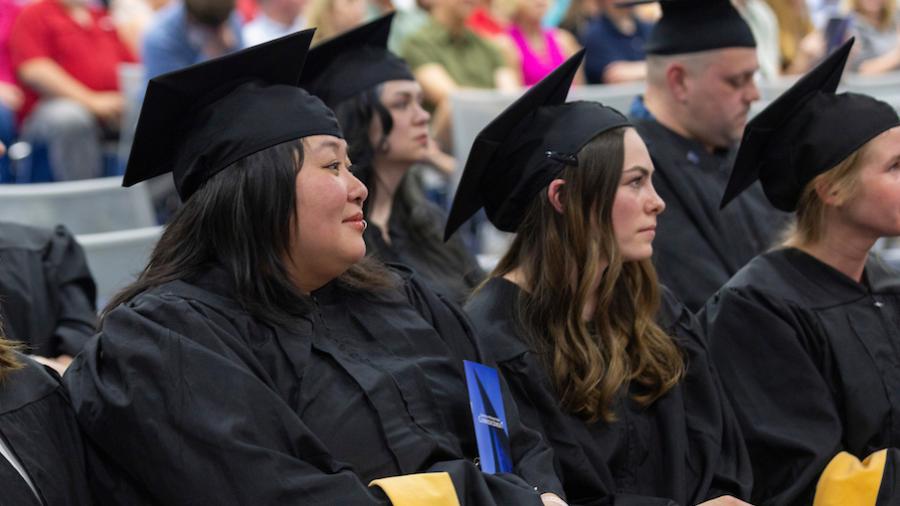
Marks received their M.S. in marriage and family therapy from UW-Stout on May 16, among more than 1,000 of their peers and hopes to continue working as a therapist with Edges Wellness Center, where they completed their practicum, refining their clinical skills and deepening their work with individuals, couples and families.
“Long-term, I hope to continue exploring healing not only through Western psychological frameworks but also through the wisdom found in indigenous culture, community, and embodied traditions,” they said. “My dream is to eventually help build communities of healers, spaces that bring together education, workshops, and collaborative learning around mental health, relationships, and collective wellbeing.
“I am immensely thankful for the mentors, peers, and opportunities that influenced my path here. In many ways, returning to UW-Stout felt like coming full circle. It’s where my curiosity about people and relationships first began, and where that curiosity has grown into a lifelong commitment to healing, learning, and community.”
Of this year’s graduates, 77.4% were hired prior to graduation, while 99% of recent graduates were employed or furthering their education within six months of graduation.
How do you hope to make an impact in your field?
More than making an impact on the field itself, what matters most to me is making a meaningful difference in the lives of the people I work with. Representation matters. As a nonbinary, immigrant, neurodivergent, and queer individual, simply showing up authentically in this field can be an act of courage, and, in its own quiet way, an act of advocacy.
Growing up, I looked up to people who were unapologetically themselves. Their visibility gave me permission to explore my own identity and imagine possibilities I had not yet seen for myself. I hope to offer that same sense of openness and belonging to others, particularly for individuals and communities who have historically been marginalized or underrepresented in spaces of care and healing.
Healing does not look the same for everyone. Culture, identity, community, and lived experiences shape how people understand suffering, resilience, and recovery. Part of my work as a therapist is honoring those differences and remaining curious about the many ways people and communities make meaning, find strength, and move toward healing.
Of course, I have professional dreams as well. I am deeply fascinated by the intersections of culture, systems, and healing, and I hope to continue exploring those questions throughout my career, whether through doctoral study or by creating educational spaces, workshops and community initiatives that support collective wellbeing.
How has UW-Stout prepared you to work in your field?
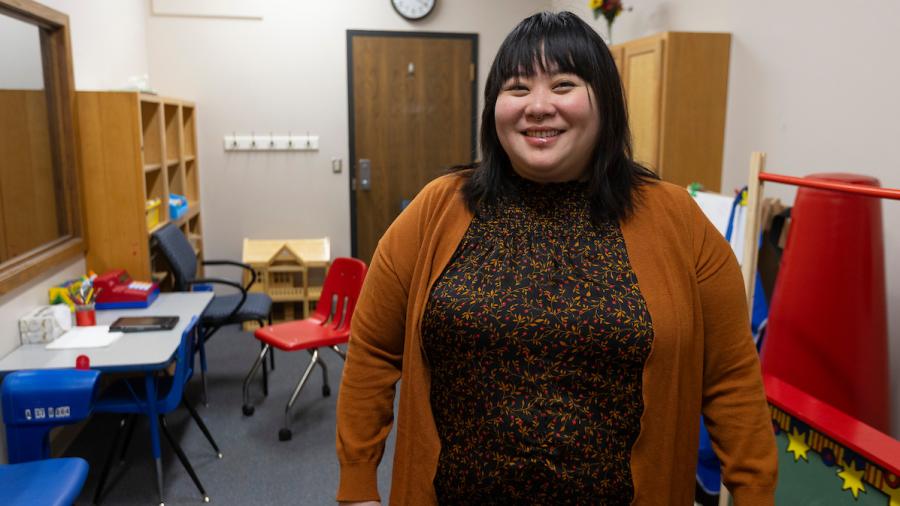
One of the most invaluable aspects of UW-Stout’s marriage and family therapy program is the counseling labs. The therapy rooms include one-way mirrors that allow professors and peers to observe sessions and provide supervision and feedback.
In addition, we use a co-therapy model, meaning two therapists work together in the room. This structure creates a powerful learning environment. It allows us to slow down, reflect and receive thoughtful guidance about how we show up as therapists. Watching my cohort members work with clients has also been incredibly formative. It has helped me see different therapeutic styles, recognize my own strengths and growth areas, and deepen my understanding of relational work.
Those experiences reflect UW-Stout’s applied learning philosophy — learning not only through theory, but through practice, reflection and collaboration.
My practicum was at Edges Wellness Center, where I worked as an individual and relational therapist. The center has offices in Menomonie, St. Paul and Minneapolis. During my time at Edges, I also volunteered to support internal organizational initiatives that strengthened collaboration and workplace culture.
While attending UW-Stout, I held a full therapy caseload, which accelerated my development as a clinician and allowed me to integrate what I was learning in class directly into my work with clients. The experience was both challenging and deeply rewarding.
Alongside my degree at UW-Stout, I’ve pursued additional training in areas that deeply interest me, including couples therapy, attachment work, decolonizing therapy, somatic approaches and trauma-processing modalities, like Brainspotting.
What stands out about your UW-Stout experience?
The culture. During my graduate experience, what stood out most was how our cohort fostered a learning environment based on collaboration, kindness and curiosity. We supported each other through challenging material, celebrated progress, and created a space where questions and feedback were welcomed and felt safe.
That kind of learning environment has a profound difference in therapy, where self-reflection and vulnerability are key to the work.
How did your involvement impact your experience?
Although my undergraduate involvement at UW-Stout was extensive, my graduate experience took place during a very different season of life. While my graduate involvement looked different, my undergraduate experience at UW-Stout played a profound role in shaping who I am today.
The foundation I built at Stout earlier in my life helped make the transition back to graduate school possible. Being a McNair Scholar as an undergrad, for example, prepared me for the expectations of graduate-level work and reinforced my belief that pursuing a master’s degree was within reach.
During my first year in the program, I stepped into an informal leadership role within my cohort, helping to advocate for changes, share feedback, and communicate updates between students and faculty. I also had the opportunity to speak with members of Psi Chi about pathways into graduate education and careers in therapy, which was a meaningful way to connect with students who are considering similar paths.
During that time, I served as a resident advisor, participated in the Honors Program, and held the positions of editor and president of Prometheus. As a McNair Scholar, I spent a summer conducting research at the University of North Texas, where I wrote and presented a research paper. I was also involved with the Hmong Stout Student Organization, the Black Student Union, and Alpha Phi Omega, and helped organize a multicultural campus event called One World.
Those experiences taught me leadership, collaboration and the courage to step outside my comfort zone. They also helped me build community and develop the confidence that eventually led me back to UW-Stout to pursue graduate education.
Looking back, both my undergraduate and graduate journeys at Stout have been invaluable. Each chapter challenged me in different ways and helped shape the person and professional I continue to become.
What challenges did you face in earning your degree, and how did you overcome them?
The biggest challenge I faced in earning my degree was the emotional and mental load of getting a graduate degree in my late 30s. Returning to school more than a decade after earning my bachelor’s degree meant balancing graduate studies while working full time, raising two pre-teen boys and supporting my family. It’s barely seeing my kids on a weekly basis, understanding the sacrifices to sleep, health and time.
It was a struggle, but I continued to remind myself that even with the challenges came the delight of greeting my cohort every week, the shared suffering and compassion for each other, and the realization that this was only temporary, which was both a relief and bittersweet.
What are you most proud of as you finish your degree?
My father graduated from UW-Stout with the same undergraduate degree I later earned in human development and family studies. He passed away three years ago, and while my master’s degree is something I pursued for myself and my family, I often find myself wishing he could see this moment. I believe he would be proud.
I am also deeply proud of the communities that helped shape me. There is a saying that it takes a village to raise a child, but I believe it also takes a village to raise a healer. The encouragement and care of my family, friends and mentors carried me through this journey.
My father’s legacy emphasized the importance of education, but what I discovered at UW-Stout is that education can be more than a path forward. It can be a way of understanding ourselves, healing our communities, and imagining a more compassionate and kind world.