





It’s one of the great ironies of the medical field that potentially lifesaving or life-improving treatments can unintentionally lead to contamination and infection. In fact, research by the U.S. Centers for Disease Control and Prevention published earlier this year found that 1 in 38 hospital patients had at least one healthcare-related infection. Such infections affect almost half a million Americans annually.
CDC research also found that nearly 40% of these infections are associated with a procedure or a medical device, highlighting the need for improved preventative measures.
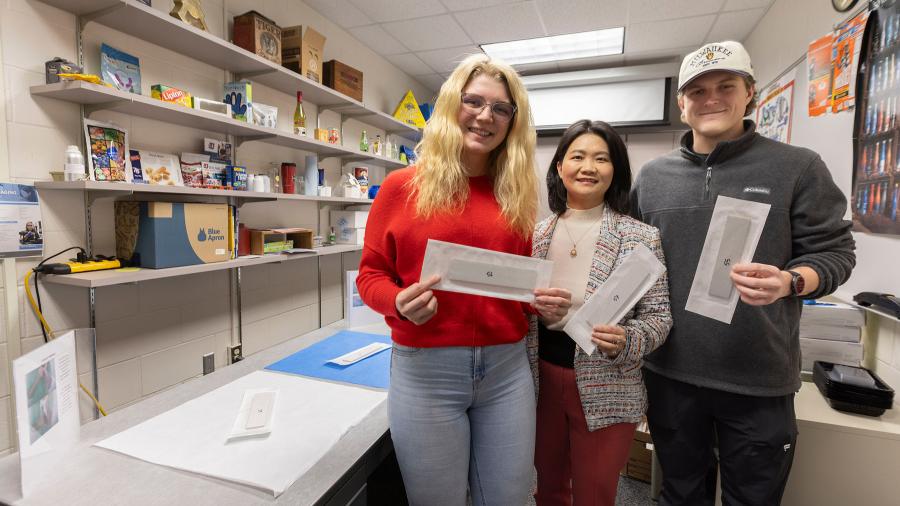
Current undergraduate and faculty research at UW-Stout Polytechnic is aimed at preventing these infections through a little-studied approach: How do the methods healthcare workers use to open sterile medical device packages impact the risk of contamination?
“There is surprisingly little experimental evidence comparing the effectiveness of different opening techniques,” Professor Min DeGruson explained. “Our team is investigating two commonly recommended methods for opening sterile medical device peel pouches and presenting devices to a sterile field.”
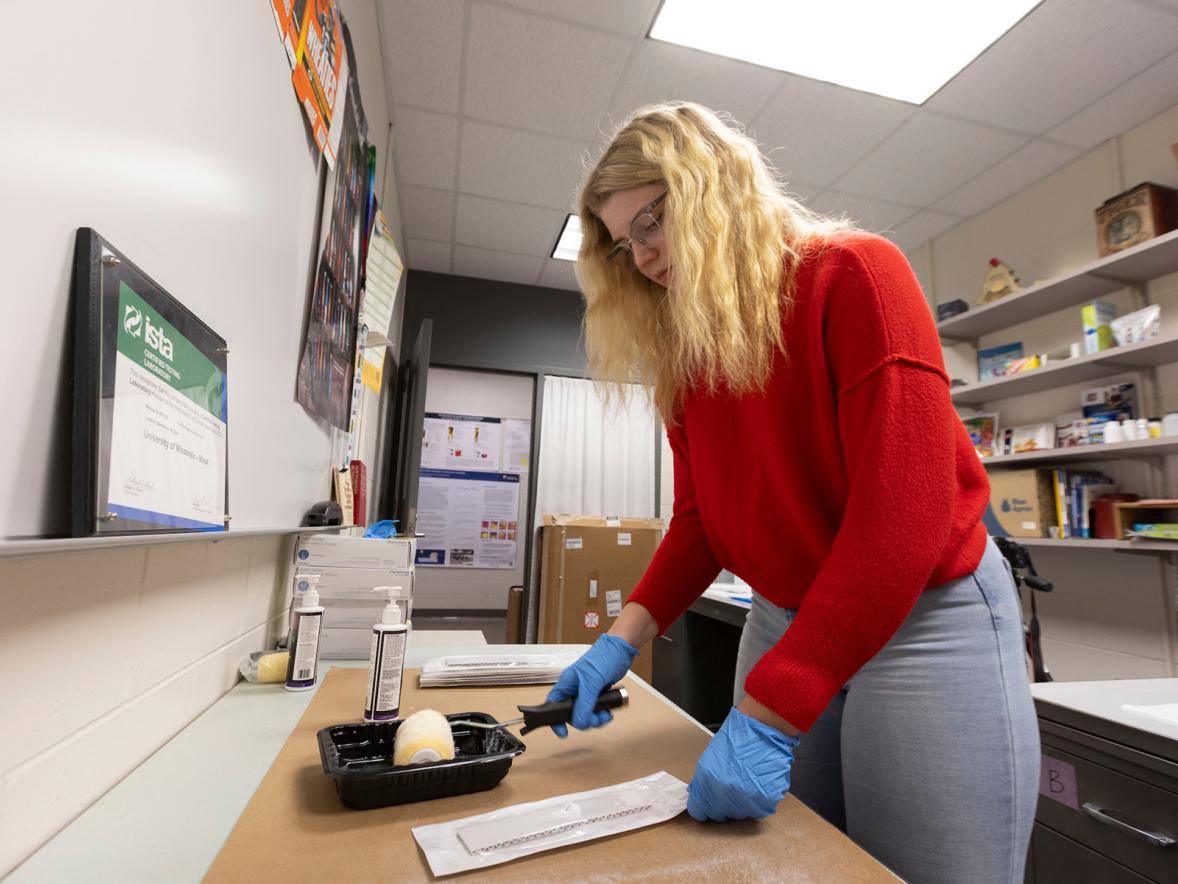
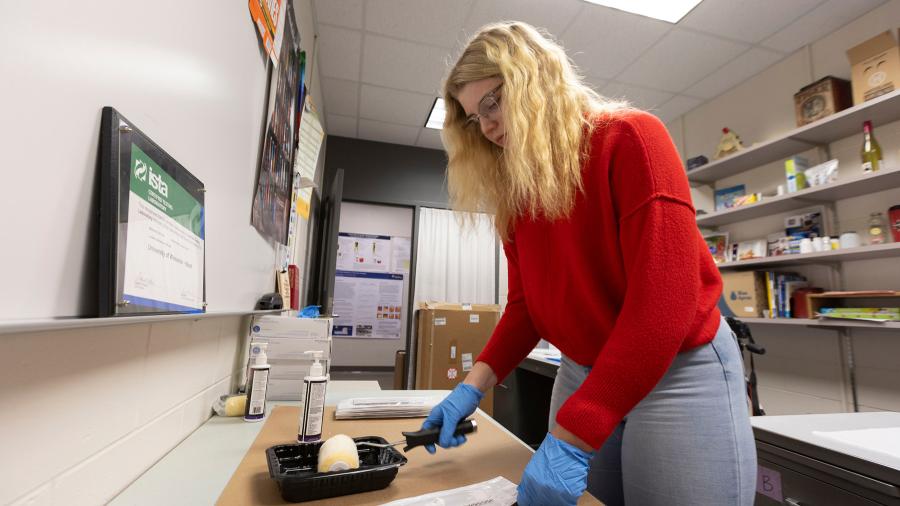
In this study, the “sterile field” is a sterile cloth on which medical professionals might lay their medical devices before surgery. The “devices,” however, are pieces of white, corrugated cardboard sealed in medical-grade plastic packages.
Research involves healthcare workers
But the cardboard isn’t the point: The focus is on what might end up on that cardboard in the process of opening the medical package. And to determine that, two UW-Stout Polytechnic undergraduates — Sam Ward of Nekoosa and Emme Felmlee of Stanley — worked with DeGruson to create a research study.
Ward and Felmlee are both senior B.S. packaging majors, while DeGruson is director of the university’s nationally ranked packaging program, which is part of the Robert F. Cervenka School of Engineering. Their study involves participants who are healthcare professionals or students. Inside a campus lab, participants are briefed on two methods of opening the medical pouch. Participants then open packages using these two methods.
The catch, Felmlee explained, is that the plastic packages are coated with a special lotion-like substance called GlitterBug. While GlitterBug is normally invisible, it glows when exposed to ultraviolet light, which makes it a useful stand-in for germs or other contaminants. To prevent potential bias, one student researcher prepares the pouches and helps participants, while the other enters the lab afterward to search for contamination with a UV light.
“Even though packaging might seem like a small part of the medical process, it plays an important role in maintaining sterility and protecting patients,” Felmlee said. “By better understanding how contamination can occur during the handling and presentation of medical devices, our research could help support improvements in packaging design, procedures and training that ultimately contribute to patient safety.”
The researchers hope to finish collecting data by February and to complete data analysis and research dissemination by May. The research may lead to published articles and potentially a whitepaper if the data shows a significant difference between the package-opening methods, DeGruson said. In addition, an abstract was submitted to the[PACK]out, a medical device packaging industry conference next May in Maryland. If accepted, DeGruson plans to bring her student researchers to present their work at the conference.
The faculty-led standalone research project is funded by a $16,000 AAMI Foundation Kilmer Fund Research Grant. These grants are awarded to selected individuals or groups working to advance the science of microbiological quality or sterility assurance. AAMI, also known as the Association for the Advancement of Medical Instrumentation, is a nonprofit organization with a global membership that spans industry, healthcare and government. The UW-Stout Polytechnic researchers are collaborating with industry experts through Kilmer Innovations in Packaging (KiiP), a multidisciplinary collaborative focused on solving healthcare packaging problems.
Project reinforces polytechnic approach
The research is giving Ward and Felmlee valuable experience in research design, data collection, problem-solving and critical thinking. Such experiences reflect the university’s polytechnic mission, which emphasizes applied learning and research, business and industry collaborations, and career-focused experiences.
“The research project will be a new addition to a growing body of data surrounding aseptic presentation,” said Tony Trier, co-chair of KiiP-Aseptic Handling group and principal packaging engineer at Network Partners Group.
Previous research has been largely focused on how packaging is designed, not how it is opened, Trier continued. “What’s really exciting about this project, in addition to building that body of evidence, is adapting methodology to inspire others to do so as well,” he said. “It’s our hope that this work will not just add to the literature, but provide a useful tool to end users for testing practices.”
DeGruson said the academic-industrial collaboration could lead to real-world improvements in healthcare. “Our goal is to generate scientific evidence that could help improve healthcare professional training, guide medical device packaging design and ultimately enhance patient safety,” she said.
The research draws on skills Ward and Felmlee developed in classes as well as during cooperative education and internship experiences. Already, Felmlee has interned at Charter Next Generation in Bloomer and completed a co-op at Nestlé Health Science in Eau Claire, while Ward had a co-op at Promega Corporation in Fitchburg. UW-Stout Polytechnic students take part in nearly 1,000 internships and co-ops annually, and 100% of Blue Devils graduate with applied-learning experience.
“This research has helped me strengthen skills I know will be valuable in my future career,” Ward said. “I’ve gained experience working collaboratively, developing and refining standard operating procedures, and troubleshooting setups and processes to be more consistent and reliable. I hope that having this hands-on research experience will help set me apart as I begin my career.”
DeGruson agreed. “I believe these experiences, especially the opportunity to contribute to research with real-world industry applications, will help students stand out as they begin their professional careers,” she said.
According to UW-Stout Polytechnic’s most recent First Destination Report, 100% of recent packaging graduates were employed within six months of graduation with an average starting salary of $75,000.